SEE THE WHOLE PACKAGE
What Charles Townshend actually did
In the summer of 1767 Parliament passed a package of measures, of which the duties are only the most famous part.
- The New York Restraining ActSuspended the New York assembly from passing any legislation at all until it complied with the Quartering Act. A colonial legislature was switched off by statute.
- The Revenue ActDuties on glass, lead, painters' colours, paper and tea imported into the colonies. The tea duty was threepence the pound. The preamble states the purpose openly.
- The Commissioners of Customs ActCreated an American Board of Customs Commissioners and seated it at Boston, putting the officials who searched warehouses and seized ships permanently in the town most likely to resent them.
- The Indemnity ActCut the duties paid on tea in England so the East India Company could undersell the Dutch tea being smuggled into America.
- The Vice Admiralty Court ActFollowed in 1768, establishing courts at Halifax, Boston, Philadelphia and Charleston. These sat without juries.
Townshend died in September 1767, three months after the Acts passed and before a word of the reaction reached London. Lord North took the Exchequer and inherited the consequences.
FOLLOW THE MONEY TO POWER
Why the preamble mattered more than the money
The duties were not expected to raise much. What made them dangerous, to anyone who read the Act, was the sentence explaining what the money was for: a more certain and adequate provision for defraying the charge of the administration of justice, and the support of civil government.
In every colony with a royal governor, the assembly voted his salary, and the judges'. It was an annual vote, and it was the only real leverage an assembly had. A governor who dissolved the house, or vetoed its bills, or ignored its petitions, still had to come back in the spring and ask for his pay. Fund those salaries out of a parliamentary duty instead and the governor stops needing the assembly at all.
So the constitutional threat was not the threepence. It was that the threepence would purchase an executive and a judiciary that the colonies could no longer reach. Dickinson saw this immediately, and it is the argument in the Letters that has aged best: Massachusetts fought exactly this battle in 1772 when Governor Hutchinson began drawing his salary from the Crown, and that quarrel produced the committees of correspondence.
EXAMINE THE PERSONA
Why a lawyer pretended to be a farmer
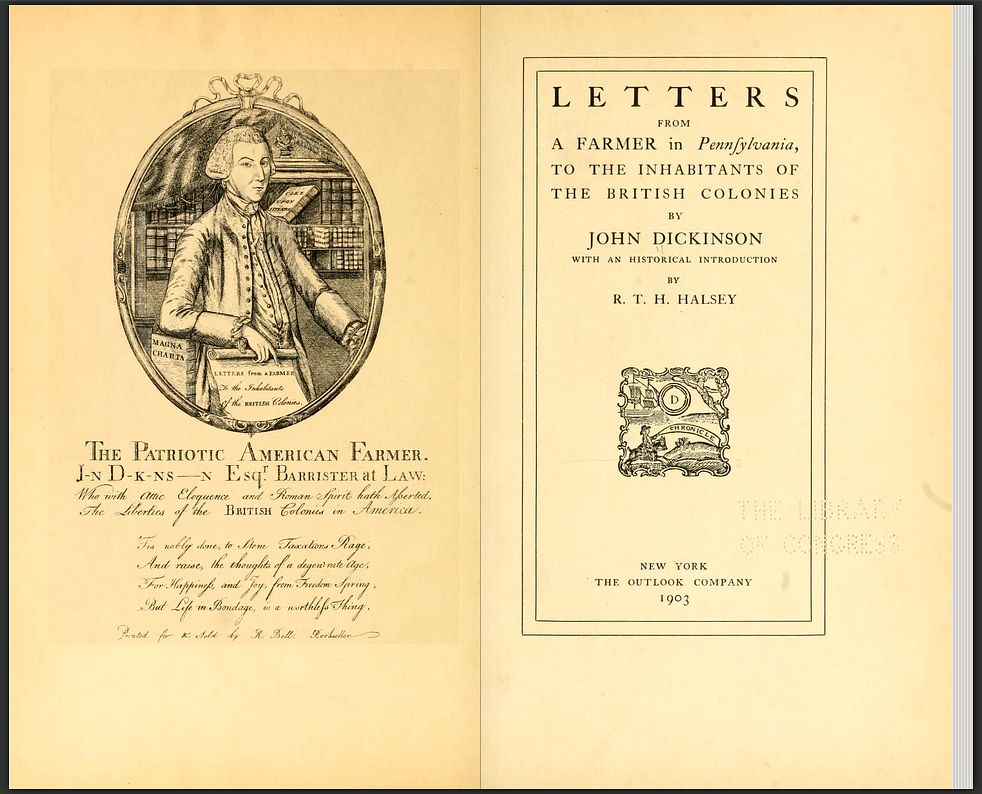
John Dickinson had one of the largest legal practices in the colonies, a Middle Temple training, and an estate on the Delaware. He was not a farmer. The persona was doing work.
A farmer with a small library and a contented mind has no faction and nothing to gain. He is not Boston, and in 1767 that mattered enormously: the middle and southern colonies had watched the Stamp Act riots with real distaste, and a great many people who thought the duties wrong were unwilling to be led by crowds pulling down houses. The Farmer offered them a way to oppose Parliament while remaining, visibly, the sort of person who disapproves of mobs.
It worked to a degree that has few parallels. The Letters ran weekly in the Pennsylvania Chronicle from December 1767, were reprinted in almost every newspaper on the continent, and came out as a pamphlet in Philadelphia, New York, Boston, Williamsburg, London and Dublin within months. Franklin wrote a preface for the London edition and helped arrange a French translation. Boston's Sons of Liberty drank the Farmer's health twice in one day at their August 1768 anniversary. Isaac Barre told the House of Commons that the author was an ornament to his country and an honour to human nature.
Dickinson also wrote the Liberty Song that summer, set to the tune of Hearts of Oak, with the line that became the slogan of the whole decade: by uniting we stand, by dividing we fall.
RESISTANCE WAS NOT YET INDEPENDENCE
What the argument cost him later
The same instincts that made the Letters persuasive in 1768 made Dickinson an obstacle in 1776. He had always argued that the object was redress inside the empire, not separation, and he would not vote for independence. He absented himself from the vote in Congress rather than block it, and never signed the Declaration.
He then went out with the Pennsylvania militia, which almost nobody else who voted against independence did. He later wrote the first draft of the Articles of Confederation, sat in the Constitutional Convention, and argued for the Constitution in print. The most widely read American political writer of the 1760s is now the least remembered of the founders, largely because of a vote he declined to cast.
FOLLOW THE CONSEQUENCES
How it ended
Not by argument. Non-importation agreements spread through 1768 and 1769: Boston and New York first, Philadelphia reluctantly in March 1769, Charleston that July, and Virginia after Governor Botetourt dissolved the Burgesses and they reconvened in a tavern to sign. British exports to the colonies fell by roughly a third in a single year, and British merchants petitioned Parliament exactly as they had in 1766.
On 5 March 1770 Lord North moved the repeal of the Townshend duties, keeping only the duty on tea as an assertion of the right. That same evening, unknown to anyone in London, soldiers fired into a crowd in King Street, Boston. The repeal passed in April. Non-importation collapsed over the following summer, New York breaking first.
Three quiet years followed. Then the Tea Act of 1773 was laid on top of the one duty that had been kept, and the quarrel resumed exactly where it had been left.
Source and interpretation notes: where this is approximate
- Parliament's case is built from documents that survive: the preambles of the Sugar Act, the Stamp Act and the Revenue Act, and the Declaratory Act. Parliamentary debates were not officially reported in the 1760s, so where a minister's reasoning is summarised rather than quoted, the page says so.
- The Farmer's side is quoted verbatim. Excerpts are cut for length and the cuts are marked; nothing is paraphrased inside quotation marks. Spelling, capitals and italics follow the 1768 Boston edition.
- The featured “fatal error” passage comes from Letter VII. It is placed in the main interpretation because Dickinson’s warning about precedent—not the amount collected—is central to the constitutional dispute.
- Trade figures for the non-importation years vary considerably between sources; the fall in British exports is given as an approximation.
- The tea duty was threepence the pound. The other rates varied by grade and are not listed here.