PRESSURE BUILDS
Five years of pressure, then eleven minutes
King Street did not come out of nowhere. It was the fifth year of a quarrel that had been escalating in steps, and each step had made the next one likelier.
In 1765 the Stamp Act produced the first intercolonial resistance: twelve stamp distributors forced out of office in eleven weeks, a congress at New York, and a merchants' boycott that brought British exporters to Parliament begging for repeal. Boston had invented the method — effigy, procession, a visit to the man's house — and it had worked without anyone being killed. Parliament repealed the Act in 1766 and, on the same day, passed the Declaratory Act asserting its right to bind the colonies in all cases whatsoever. Each side read the outcome as a win.
In 1767 Charles Townshend tested that reading with duties on glass, lead, paint, paper and tea, and did something more consequential than the duties themselves: he created an American Board of Customs Commissioners and sat it in Boston. The town now housed, permanently, the officials whose job was to search its warehouses and seize its ships, tried in vice-admiralty courts without juries.
In 1768 the Board seized John Hancock's sloop Liberty, a crowd went for the customs officers, and the officers fled to an island fort in the harbour and asked for protection. In October, troops landed. Roughly two thousand regulars came ashore into a town of about sixteen thousand people, and were quartered not in barracks outside it but in the town itself — in warehouses, in Faneuil Hall, in tents on the Common. To a political culture raised on the belief that a standing army in peacetime was the instrument by which free states were turned into unfree ones, this was not an inconvenience. It was the thing itself, arriving.
By 1770 two regiments remained, and the friction had become daily and physical. Soldiers on low pay took casual work in their off-duty hours, undercutting Boston labourers in a slack economy, which put the two groups in direct competition for the same wages. There were fights.
The six weeks before
On 22 February 1770 a customs informer named Ebenezer Richardson, besieged in his house by a crowd throwing stones at an importer's shop next door, fired into the street and killed Christopher Seider, an eleven-year-old boy. Samuel Adams organised the funeral. Something like two thousand people walked behind the coffin. A jury convicted Richardson of murder that April; the judges declined to pass sentence, and he was eventually pardoned from London, which was read in Boston as confirmation that the Crown would not let its servants be punished.
On 2 and 3 March soldiers and workers brawled at John Gray's ropewalk, after a ropemaker answered a soldier asking for work by telling him to go and clean his outhouse. The fights went on for two days and drew in dozens of men from the 29th Regiment.
King Street was eleven days after Seider's funeral and two days after the ropewalk.
RECONSTRUCT THE SEQUENCE
The night itself
It began with a debt. On the evening of 5 March 1770 a wigmaker's apprentice called out to a British officer about an unpaid bill, and the sentry outside the Custom House, Private Hugh White, struck him with the butt of his musket. A crowd gathered. Church bells rang, which in Boston meant fire, which brought more people out with buckets and, it being a crowd on a cold night, with whatever else came to hand.
White retreated up the Custom House steps and called for help. Captain Thomas Preston brought a relief party of seven men of the 29th through the crowd and formed them in front of the building. Several hundred people pressed in. They threw snowballs, ice, oyster shells and sticks, and they shouted at the soldiers to fire, which men who want to see whether a bluff is real do.
Private Hugh Montgomery was knocked down by something thrown. He got up and fired. After a pause the others fired raggedly, over several seconds, some without orders and some apparently thinking an order had been given. Eleven men were hit. Crispus Attucks, Samuel Gray and James Caldwell died in the street. Samuel Maverick, seventeen, died the next morning. Patrick Carr died on 14 March, after telling his doctor that he thought the soldiers had been provoked and had fired to defend themselves.
Preston and eight soldiers were arrested within hours. The troops were pulled out of the town to the harbour fort. Boston's own militia companies patrolled the streets, to demonstrate that the town could keep order without an army in it.
A PICTURE THAT LOOKED LIKE PROOF
Why the print mattered more than the pamphlets
Both sides understood immediately that this was a fight about the account, not the facts. Within a week Boston's town meeting had appointed James Bowdoin, Joseph Warren and Samuel Pemberton to gather depositions; they collected ninety-six and rushed them into print as A Short Narrative of the Horrid Massacre in Boston. Lieutenant-Colonel Dalrymple's people were collecting their own at the same time, and about thirty of those reached London as A Fair Account of the Late Unhappy Disturbance at Boston. Preston published his own version in a London newspaper from his cell.
The illusion of simply showing
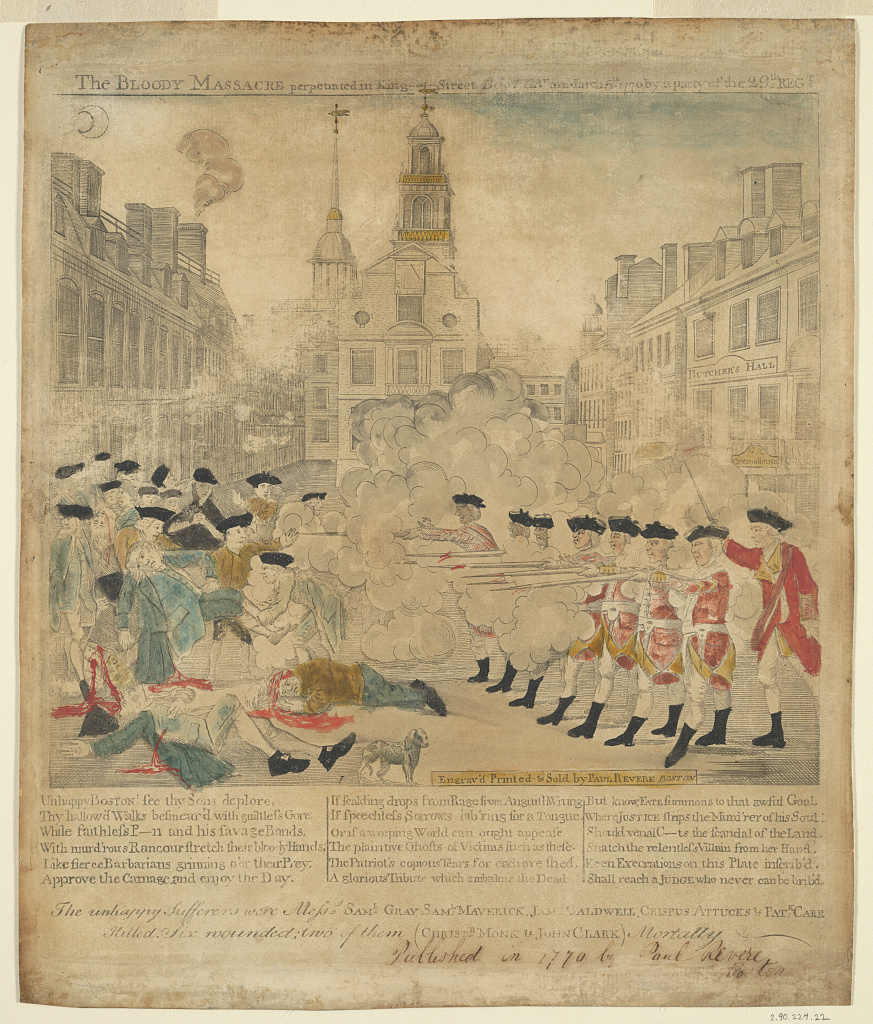
A pamphlet of ninety-six depositions is an argument. It has to be bought, read and weighed, and it invites the reply that came. The engraving is not an argument. It is a picture of something that happened, and pictures do not appear to be making a case — they appear to be showing you. That is the whole of its power, and it is why the hand-coloured sheet outran the pamphlets on both sides of the Atlantic while being, point for point, the least reliable document any of them produced.
Three other things made it work. It was fast: on sale on 26 March, seven months before a jury heard a word of evidence, so it defined the event before the event had been adjudicated. It was cheap and copyable: a print could be bought, pinned to a wall, and re-engraved by anyone with a plate, which is exactly what happened. And it came with eighteen lines of verse and a list of names, so the viewer was told what to feel and given martyrs to attach the feeling to.
It also supplied the word. Boston's newspapers were calling it a massacre within a week, and Revere's title fixed it. That word was not neutral in 1770: it had entered English around 1600 to describe the St Bartholomew's Day killings of French Protestants, and it carried the smell of religious atrocity. A Fair Account spent a page objecting to it, arguing that a resistance by a dozen soldiers against a hundred men with clubs bore no resemblance to the slaughter of the Protestants of France in 1572 or of Ireland in 1641. That complaint was correct on the merits and lost completely, because Revere had already put the word under a picture.
Worth preserving Who actually drew the image—and why Revere beat him to the public?
Not Revere. Henry Pelham was twenty, the half-brother of the painter John Singleton Copley, and he had made the design. At some point he showed it to Revere, an established silversmith and engraver with a shop, a press and a market. Revere advertised his own version for sale on 26 March. Pelham's went on sale on 2 April, a week late into a market Revere had already taken.
On 29 March Pelham wrote him a letter. He said he had trusted Revere with the plate as he would have trusted a friend, accused him of one of the most dishonourable acts he could well have been guilty of, and compared being robbed by a person he had shared his work with to being robbed on the highway. Nobody knows whether the letter was ever sent, and Revere — who kept no diary — left nothing at all on the subject.
Two things are worth holding at once here. The first is that there was no copyright in engraved designs in the colonies. Britain had protected engravers since 1735, but the Act did not run in America, and copying prints was an ordinary, unremarkable trade practice. Pelham's grievance was not legal and he did not frame it as one; he framed it as a betrayal by someone he had let see unfinished work.
The second is that Revere's speed was not incidental to what the image did. Pelham made a picture. Revere made a weapon, and the difference is mostly three weeks and a shop on the main street. He added the title, the verse, the roll of the dead and the sign reading Butcher's Hall — which is to say he added everything that turned a depiction into an accusation.
The copying did not stop with him. A Newburyport clockmaker named Jonathan Mulliken re-engraved Revere's version. A London printer issued another. Revere himself cut a simplified woodcut of his own image for Isaiah Thomas's almanac for 1772. The picture that Pelham complained had been stolen from him became, within two years, a thing that belonged to nobody and circulated everywhere, which is what a successful piece of propaganda looks like from the inside.
FOLLOW THE NETWORK
Where it travelled, and how it landed
In the colonies
The print went out along the same network the Stamp Act resistance had built: newspapers, merchants' correspondence, committees. It was used as the frontispiece to the Boston committee's own pamphlet, which fused the visual claim and the sworn testimony into one object. Copies and re-engravings spread from New Hampshire to Georgia.
It also became a ritual. On 5 March 1771, the first anniversary, Revere lit his windows from inside and put his prints in them so that passers-by saw the images glowing in the dark. Boston held a Massacre Day oration every year from 1771 until 1783, with Joseph Warren, John Hancock and others taking the platform in turn, and Christopher Monk — a wounded man who never recovered — was reportedly shown to the crowds as a living exhibit.
In London
On 1 April the town meeting hired a sloop and sent its report to England, and it sent the prints with it. They found a ready audience, but a particular one. In May a British edition of the Short Narrative appeared in London from William Bingley, a radical printer in the circle of John Wilkes, with an engraving of the killings as its frontispiece; Bingley also sold a separate print of the scene for sixpence. That is where the image landed in Britain: not on the ministry, which had already received Dalrymple's depositions and was unmoved, but among the domestic opposition, who had their own quarrel with the same government and were glad of the ammunition.
The ministry's own reading of King Street was that the soldiers had been provoked, and it was not much shaken. When news of Preston's acquittal reached London in December it was greeted with relief and treated as evidence that the Bostonians had overplayed their hand.
The awkward timing
On the very day of the shooting, 5 March 1770, Lord North moved in the Commons to repeal the Townshend duties — all of them except the duty on tea, kept as a matter of principle. Neither side knew. The news crossed in both directions over the following weeks, so the most inflammatory image of the decade went into circulation exactly as the grievance that produced it was being partly withdrawn.
PLACE IT ON THE ROAD TO REVOLUTION
How one night in Boston became a colonial warning
People throughout the colonies did not witness the confused shooting in King Street. They encountered versions of it: newspaper reports, letters, pamphlets, coffin images, and Revere's orderly line of redcoats firing into apparently helpless civilians. Patriot printers and correspondents carried Boston's interpretation outward. Loyalists and imperial officials answered that the crowd had attacked the soldiers, while the later verdicts showed that even a Boston jury did not accept every accusation printed beneath the engraving.
The print gave distant colonists a scene they could understand at a glance. Boston's confrontation could now be discussed as evidence about the empire, not merely as one town's street violence.
Colonists had long warned that a standing army in peacetime could enforce power without consent. The dead in King Street made that constitutional argument immediate, emotional, and human.
Annual Massacre Day displays and orations kept the story alive. When conflict renewed over tea in 1773 and punishment in 1774, Patriot leaders could present those measures as part of an accumulating pattern.
The Massacre did not make independence inevitable. Parliament was already retreating from most Townshend duties, the troops left central Boston, and the imperial crisis quieted for several years. Its importance lay in the political memory it created: British taxation, customs enforcement, military occupation, and bloodshed could be arranged into one story about what unchecked imperial power might do.
That is why the engraving belongs on this road. It did more than report an event. It helped colonists recognize a pattern, preserve a grievance, and carry Boston's warning across colonial borders. The Library of Congress describes the Massacre as a symbol of British tyranny and an important stepping stone toward rebellion.
THE VERDICTS THE PRINT CANNOT SHOW
The trials, and the fact that Boston acquitted them
This is the part the print makes hardest to see, and it is the most creditable thing anyone did that year.
John Adams took the defence. He was thirty-four, ambitious, a cousin of Samuel Adams, and he had every political reason to refuse. Josiah Quincy II joined him. Preston was tried in late October 1770 and acquitted: the jury was not satisfied that he had given an order to fire, and the evidence was that he had been standing in front of his own men's muskets, which is not where a man stands when he intends them to shoot.
The eight soldiers were tried separately from 27 November. Six were acquitted. Montgomery and Matthew Kilroy were convicted of manslaughter rather than murder, pleaded benefit of clergy, were branded on the thumb and released. Adams used Patrick Carr's deathbed statement — that the soldiers had been provoked, and that he did not blame the man who shot him — admitted as a dying declaration, which was hard for the prosecution to answer because Carr was one of the five the print called martyrs.
A separate case followed the print's other accusation. Four civilians — Edward Manwaring, John Munro, Hammond Green the Custom House porter, and Thomas Greenwood — were charged with firing on the crowd from the Custom House windows. The sole witness was Manwaring's French servant boy, Charles Bourgatte. All four were acquitted, and Bourgatte was convicted of perjury; there were persistent rumours that patriot organisers had put him up to it.
So a Boston jury, in a town that had buried five of its own ten months earlier, heard the evidence and declined to convict. That verdict and this engraving are documents about the same night, and they do not agree. Adams thought his part in it one of the best services he ever did his country, and he was right, but the print is what the country remembered.
ABSENCE ALSO MAKES AN ARGUMENT
The afterlife of a figure who is not in it
Crispus Attucks was about forty-seven, a sailor and dockworker of African and Native descent who had escaped slavery in Framingham twenty years earlier. He was at the front of the crowd, he was among the first killed, and he was the most conspicuous person there.
He is not identifiable as a man of colour in the print. The hand-colouring varies between surviving impressions, and at least one has watercolour applied to distinguish a face; but in the great majority the five dead are white men, and no contemporary print of the Massacre depicts him otherwise. The earliest known image showing Attucks as a person of colour was drawn in 1855, eighty-five years later.
That gap is the point. In 1770 an image meant to unite the colonies against the army had no use for a Black man at the centre of the story, and the men who made it were not going to build one. In the 1850s, when William C. Nell and the Boston abolitionists went looking for Black patriots to set against the claim that Black Americans had no stake in the Republic, Attucks was exactly what was needed, and he was put back into the picture. Boston kept a Crispus Attucks Day from 1858. The monument on the Common went up in 1888, over the objections of those who thought the men in King Street had been a mob.
The same figure was left out of one propaganda campaign and made central to another, by the same method, for opposite ends, in the same city.
Source and interpretation notes: where this account is uncertain
- The number of troops in Boston is given differently in different sources: roughly two thousand arrived in 1768 into a town of about sixteen thousand, but two regiments were withdrawn in 1769 and the 1770 figure was considerably lower.
- The size of the crowd on 5 March is unknowable. Contemporary estimates run from fifty to several hundred, and both pamphlets had an interest in the answer.
- The Town House clock in the print is often said to show the wrong time in the earliest impressions, corrected in later ones. Impressions differ and the detail is small; treat it as reported rather than established.
- The hand-colouring of the dead varies between surviving copies, so statements about how Attucks appears are true of most impressions rather than all.
- Pelham's letter of 29 March 1770 survives, but there is no evidence it reached Revere and no reply of any kind.
- The order to fire. A jury found that Preston did not give one. That is a verdict, not a certainty; witnesses contradicted each other flatly, and some heard the word fire from the crowd.
- The diagram on this page is a schematic of where things sit in the composition. It is not to scale and is not a reproduction. Look at the original.
TRACK EVENT, PUBLICATION, AND VERDICT
Dates
- Christopher Seider, eleven years old, shot dead by the customs informer Ebenezer Richardson.
- Brawls between soldiers and workers at Gray's ropewalk.
- The shooting in King Street. Lord North moves repeal of the Townshend duties in London the same day.
- Funeral procession for the dead, said to have drawn a crowd comparable to the whole population of the town.
- A Short Narrative of the Horrid Massacre completed, with ninety-six depositions.
- Revere advertises the engraving for sale.
- Henry Pelham writes to Revere accusing him of theft.
- The town meeting sends a sloop to England with the report and the prints.
- Pelham's own version goes on sale, a week behind.
- London editions: the Short Narrative from Bingley, and A Fair Account for the other side.
- Captain Preston acquitted.
- Six soldiers acquitted; two convicted of manslaughter and branded.
- Manwaring and three others acquitted of firing from the Custom House; the witness convicted of perjury.
- First Massacre Day. Revere lights his prints in his windows.
- First known depiction of Crispus Attucks as a man of colour.