Topic Sentence
Bluntly answer the question. Reuse its essential words so the reader never has to infer what you mean.
SAQ Lab · Unit 1
Build direct, specific answers to stimulus-based AP U.S. History short-answer questions with T.E.A.: Topic Sentence, Evidence, and Analysis.
The current SAQ
Beginning with the May 2027 exam, students answer three required SAQs in 40 minutes. Question 1 uses secondary text source material, Question 2 uses a primary text source, and Question 3 uses a primary or secondary non-text source. Each A, B, and C response is worth one independent point.
The method
T.E.A. is a reasoning routine, not an official sentence-count rule. A strong response is usually two to four focused sentences. Write enough to complete the task—then stop.
Bluntly answer the question. Reuse its essential words so the reader never has to infer what you mean.
Name and describe something specific. An isolated term is not enough to demonstrate what you know.
Explain the connection. State how or why the evidence supports the answer you gave.
Borrow the frame; supply the answer
Prompt: Briefly explain one cause of the historical development named in the question.
T: One cause of the historical development named in the question was ______.
E: Specifically, ______.
A: This caused the development because ______.
The repeated words establish the topic. The student—not the scaffold—must provide the historical answer.
Worked Period 1 primary-source example
This teaching example is separate from the three questions in the Unit 1 practice collection. Read the source, identify the exact task in each part, and notice how each topic sentence borrows the prompt’s language before giving a blunt answer.
“The people of this island, and of all the other islands which I have found and seen, go naked as they were born. They have neither iron nor steel nor arms, and are not capable of using them—not because they are weak, but because they are timid. They are so unsuspicious and so generous with what they possess that no one would believe it who had not seen it. They never refuse anything that is asked for; on the contrary, they invite us to ask them. They give things of great value for trifles and are satisfied with very little in return. I gave them many beautiful and pleasing things which I had brought, so that they might be drawn to our holy faith and become inclined to love and serve Their Highnesses and the whole Spanish nation, and to help us by giving the things of which they have abundance and which are necessary to us.”
(A) Briefly describe one perspective Columbus expresses in the passage about Indigenous peoples.
(B) Briefly explain one development from 1491 to 1607 that contributed to Columbus’s perspective in the passage.
(C) Briefly explain one effect from 1491 to 1607 of ideas about Indigenous peoples similar to those expressed in the passage.
A: One perspective Columbus expresses about Indigenous peoples is that they were generous and could be brought under Spanish and Christian authority. He describes people exchanging valuable goods for small objects and says his gifts would incline them toward Christianity and service to the Spanish monarchs. His description treats generosity and unfamiliarity with European weapons as signs that Spanish influence could be established easily.
Why this is exemplary: It states a defensible perspective—not merely a topic—and supports that reading with two connected details from the passage.
B: One development that contributed to Columbus’s perspective was Spain’s recent completion of the Reconquista and the monarchy’s support for Catholic expansion. In 1492 Ferdinand and Isabella defeated Granada, the last Muslim-ruled kingdom in Iberia, and then sponsored Columbus’s voyage. That combination of royal expansion and religious mission encouraged Columbus to view contact as an opportunity to claim subjects and spread Christianity.
Why this is exemplary: It names a specific development within the period and explains how that context shaped the perspective expressed in the source.
C: One effect of similar ideas about Indigenous peoples was the growth of coercive Spanish labor and conversion systems. Under encomienda, Spanish colonists demanded Indigenous labor and tribute while claiming that they would provide protection and Christian instruction. Viewing Native peoples as potential subjects in need of Spanish rule helped colonizers justify controlling their labor and religious life.
Why this is exemplary: It identifies a concrete effect and makes the causal link between the source’s ideas and a colonial institution explicit.
T direct answer E specific evidence A explicit connection
Choose a unit
Units 1 and 2 are active. Each unit keeps its own responses, mode, and last-opened question in this browser tab.
Unit practice: The active collection keeps all three questions within the selected unit. Full sets combining multiple historical periods will appear separately under Exam Review.
Choose a question
These labels describe source formats. On the exam, the three formats concern different historical periods.
Reserved for later
Future full-section sets will combine three required questions from three different historical periods and provide an optional 40-minute practice mode. They will remain separate from the unit-by-unit teaching collection.
Unit 1 · Question 1 · Secondary text sources
This instructional source set paraphrases two published historical interpretations. It does not reproduce a College Board question.
European arrival joined ecosystems that had long developed separately. Old World pathogens caused catastrophic mortality among Indigenous populations, while introduced animals and plants altered American environments and economies. These biological exchanges gave Europeans advantages that military actions alone cannot fully explain.
Early contact should not be understood only as Europeans acting upon passive Indigenous peoples. Native nations pursued their own interests through trade, diplomacy, migration, resistance, and alliances. European footholds developed within Indigenous political worlds that newcomers did not initially control.
Crosby: Biological and environmental exchange drove change.
Richter: Indigenous agency and Native political relationships shaped events.
Do not overstate: Different emphases do not mean the historians disagree about every fact.
(A) Briefly describe one important difference between Crosby’s and Richter’s interpretations of change in the Americas following European arrival.
(B) Briefly explain how one specific historical event, development, or circumstance from 1491 to 1607 that is not directly mentioned in the passages could be used to support Crosby’s interpretation.
(C) Briefly explain how one specific historical event, development, or circumstance from 1491 to 1607 that is not directly mentioned in the passages could be used to support Richter’s interpretation.
Open this only if you want help translating each task verb into an action.
Your response
If one part is difficult, continue to the others. Each point stands alone.
Review after drafting
A: One important difference between Crosby’s and Richter’s interpretations is that Crosby emphasizes biological exchange as the main driver of change, while Richter emphasizes the decisions and power of Indigenous peoples. Crosby focuses on disease and introduced species, whereas Richter focuses on Native trade, diplomacy, resistance, and alliances. Thus, Crosby explains change largely through ecological forces, while Richter explains it through human agency within Native political worlds.
B: One development that supports Crosby is the smallpox epidemic that struck central Mexico during the campaign against the Mexica. The disease killed many Indigenous people, including leaders and warriors who had no previous exposure to it. An Old World pathogen therefore weakened the Mexica beyond what Spanish military power alone could have accomplished.
C: One development that supports Richter is the alliance between the Tlaxcalans and Cortés. The Tlaxcalans supplied thousands of warriors and used the Spanish arrival to fight their Mexica rivals. Indigenous political choices and rivalries therefore helped determine the outcome of conquest.
T direct answer E specific evidence A explicit connection
A: “Crosby talks about disease, but Richter talks about Native Americans.”
B: “Smallpox supports Crosby.”
C: “Native alliances support Richter.”
Unit 1 · Question 2 · Primary text source
Read the source as an argument by a reform-minded Spanish friar, not as a neutral transcript of every encounter.
“The Spaniards first assaulted the innocent sheep, like most cruel tigers, wolves, and lions hunger-starved, studying nothing for the space of forty years after their first landing but the massacre of these people, whom they have inhumanely butchered and harassed with several kinds of torments. . . . Now this prodigious slaughter and ruin of men was begun and brought about by the Spaniards on account of their insatiable thirst after gold. . . . And this was the great care they had of them: they sent the men to the mines to dig and bring away the gold, which is an intolerable labor; but the women they made use of to manure and till the ground, which is a toil most irksome even to men of the strongest constitutions, allowing them no other food but herbage and such unsubstantial nourishment. The men died in the mines with labor and famine, and the women died in the fields, so that the generation of the people ceased.”
Excerpt combined from the general account and the section on Hispaniola; spelling, capitalization, and punctuation lightly modernized. Las Casas used extreme contrasts and religious language to persuade the Spanish Crown to reform colonial treatment of Indigenous peoples.
Claim: Spanish colonizers committed sustained and brutal violence against Indigenous peoples.
Purpose: Las Casas sought reform, so his forceful language is meant to persuade.
Avoid: Quoting his metaphor as though the quotation explains itself.
(A) Briefly describe one claim Las Casas makes in the passage about Spanish treatment of Indigenous peoples.
(B) Briefly explain one development from 1491 to 1607 that led Las Casas to express the point of view shown in the passage.
(C) Briefly explain one action taken by Spanish authorities from 1491 to 1607 in response to debates over the treatment of Indigenous peoples.
Open this only if you want help translating each task verb into an action.
Your response
The source provides evidence and point of view. Your historical knowledge completes the response.
Review after drafting
A: One claim Las Casas makes is that colonizers used systematic and extreme violence against largely defenseless Indigenous peoples. He portrays Spaniards as predators who massacred and tortured Native communities over many years. His language condemns conquest as sustained brutality rather than restrained conversion.
B: One development that led Las Casas to express this point of view was the expansion of the encomienda system. The Crown granted colonists the right to demand labor and tribute from Indigenous communities in exchange for supposed protection and Christian instruction, and Las Casas observed the resulting exploitation in the Caribbean. Those abuses helped turn him from an encomienda beneficiary into a Dominican critic who urged the Crown to restrain colonial violence.
C: One action Spanish authorities took in response to debates over Indigenous treatment was the New Laws of 1542. The Crown attempted to restrict Indigenous enslavement and prevent encomiendas from becoming permanent hereditary grants. The policy answered reformers’ criticism by trying to limit colonists’ control, although colonial resistance made enforcement uneven.
T direct answer E specific evidence A explicit connection
A: “Las Casas says the Spanish were cruel.”
B: “The Spanish wanted gold, so Las Casas disagreed with them.”
C: “The New Laws ended the encomienda system.”
Unit 1 · Question 3 · Secondary non-text source
This graph visualizes one influential scholarly estimate. Exact precontact population totals remain debated; the steep direction of decline is the historical pattern to analyze.
| Year | Estimated population |
|---|---|
| 1519 | 25.2 million |
| 1532 | 16.8 million |
| 1548 | 6.3 million |
| 1568 | 2.65 million |
| 1580 | 1.9 million |
| 1595 | 1.375 million |
| 1605 | 1.075 million |
Source note: Cook and Borah developed these estimates from colonial records. Historians debate precise totals, but documentary and archaeological evidence strongly supports catastrophic population decline after contact.
What it shows: The estimate falls by more than 90 percent, especially rapidly in the decades after 1519.
What it cannot show: A graph displays a pattern; it does not identify causes by itself.
Use numbers selectively: Describe the scale and direction, then explain with historical knowledge.
(A) Briefly describe one important pattern shown in the graph.
(B) Briefly explain one specific historical factor that contributed to the pattern shown in the graph from 1519 to 1605.
(C) Briefly explain one effect of the demographic pattern shown in the graph on colonial labor systems in the Americas before 1607.
Open this only if you want help translating each task verb into an action.
Your response
First read the visual accurately. Then use historical knowledge to explain causes and effects.
Review after drafting
A: One important pattern is a catastrophic decline in central Mexico’s estimated Indigenous population. The estimate falls from about 25.2 million in 1519 to roughly 1.1 million in 1605, with especially rapid losses before 1568. The data indicate a loss of well over ninety percent in less than a century.
B: One factor that contributed to the decline was the spread of Old World diseases such as smallpox. Indigenous populations had little prior exposure or immunity, allowing epidemics to spread rapidly after contact. Repeated epidemics caused high mortality and disrupted food production and community care.
C: One labor-system effect was increased Spanish reliance on enslaved African labor. As Indigenous populations declined while colonists demanded workers for mines and plantations, Spain expanded the transport of enslaved Africans. Demographic collapse therefore helped colonists seek another coerced labor force.
T direct answer E specific evidence A explicit connection
A: “The population went down because of disease.”
B: “Disease killed many Indigenous people.”
C: “The decline caused slavery.”
Before you begin: This separate reference section is classroom support, not part of the SAQ. On the AP exam, you will receive the question and its stimulus, but not this additional background briefing. Read it if needed, then select evidence yourself and explain its relevance.
George Whitefield preached the need for personal conversion in multiple mainland colonies. Benjamin Franklin printed and sold his sermons and journals in Philadelphia, extending the audience beyond people who heard him in person.
Gilbert Tennent’s sermon The Danger of an Unconverted Ministry argued that some formally appointed ministers lacked genuine conversion.
The Presbyterian Synod of Philadelphia split over revival-related disputes into Old Side and New Side camps. The division lasted beyond 1754.
Joining a revival did not itself change voting requirements, end established churches, or free enslaved people. Religious participation and legal equality were different matters.
Background references: Christine Leigh Heyrman, National Humanities Center · Presbyterian Historical Society, Synod of Philadelphia records.
SAQ begins here · Unit 2 · Question 1 · Secondary interpretations
The revivals of the 1730s and 1740s encouraged intense personal conversion and prompted disputes within Protestant churches. The excerpts below come from two historians assessing the colonial revivals. Read each passage and answer parts A–C.
Early American evangelicalism was distinguished from earlier forms of Protestantism by dramatically increased emphases on seasons of revival, or outpourings of the Holy Spirit, and on converted sinners experiencing God’s love personally. Both the role of the Spirit and the methods of revival were hotly contested among early American evangelicals. […]
In this book I present evangelicalism as having fluid boundaries that changed over time. Instead of Old Lights and New Lights, we should think of the debates over this movement in terms of three points on a continuum. On one end were the antirevivalists, who dismissed the revivals as religious frenzy or “enthusiasm.” In the middle were the moderate evangelicals, who supported the revivals at their outset but became concerned about the chaotic, leveling extremes that the awakenings produced. Finally, on the other end were the radical evangelicals, who eagerly embraced the Spirit’s movements, even if social conventions had to be sacrificed.
The label “the Great Awakening” distorts the extent, nature, and cohesion of the revivals that did exist in the eighteenth-century colonies, encourages unwarranted claims for their effects on colonial society, and exaggerates their influence on the coming and character of the American Revolution. […]
No one would seriously question the existence of “the Great Awakening” if historians only described it as a short-lived Calvinist revival in New England during the early 1740s. Whether stimulated by Edwards, James Davenport, or the British itinerant George Whitefield, the New England revivals between 1740 and 1745 obviously were Calvinist ones. […] Yet, Calvinism never dominated the eighteenth-century religious revivals homogenized under the label “the Great Awakening.” The revivals in the middle colonies flowed from especially disparate and international sources. John B. Frantz’s recent traversal of the German revivals there demonstrates that they took root in Lutheranism, German Reformed Calvinism (different from the New England variety), and Pietism (however one wants to define it).
Kidd: two selections from pp. xiv–xv; […] marks omitted intervening sentences. Original italics are retained, page-layout line breaks and line-wrap hyphenation are removed, and endnote markers are omitted. Butler: three selections from pp. 308–309; each […] marks omitted text between selections. Page-layout line breaks and line-wrap hyphenation have been removed; Butler’s wording has not been paraphrased. Kidd: publication record · Butler: publication record.
Both historians recognize religious revival and disagreement. Kidd describes a distinctive evangelical movement, then distinguishes opponents, moderate supporters, and radicals within it. Butler cautions that one label can hide different religious roots across colonies, contrasting Calvinist New England with the middle colonies. Explain their different emphases without treating either author as claiming perfect unity or no revival.
A development can connect people and create conflict at the same time. Explain which part of your example supports the assigned interpretation.
The background reference supplies facts, not prewritten matches. You may use these facts or other accurate evidence within the dates.
(A) Briefly explain one important difference between Kidd’s and Butler’s interpretations of the colonial revivals. Support your explanation with a detail from each passage.
(B) Briefly explain how one specific development from 1730 to 1754, beyond the general claims in the passages, supports Kidd’s interpretation of religious transformation.
(C) Briefly explain how a different specific development from 1730 to 1754 supports Butler’s caution about a single, shared colonial religious experience.
Your response
Each part stands alone. Give a direct answer, specific evidence, and the connection between them.
Review after drafting
These are examples, not the only defensible answers. T.E.A. is a reasoning routine, not a required sentence count.
A: Kidd describes an emerging evangelical movement with internal disagreements, while Butler questions whether one “Great Awakening” label adequately represents different colonial revivals. Kidd identifies renewed attention to revival and personal conversion, then places antirevivalists, moderate evangelicals, and radicals on a continuum. Butler acknowledges Calvinist revivals in New England but identifies Lutheran, Reformed, and Pietist roots in the middle colonies. Kidd uses disagreement to describe the contested shape of a changing movement; Butler uses differences among regional revivals to question how much one label can explain. Both can be right that revivals occurred and varied.
Why this works: The answer uses specific details from both excerpts and explains the different uses each historian makes of variation. It does not invent an all-or-nothing disagreement.
B: One development supporting Kidd’s interpretation was the circulation of Whitefield’s preaching through print in 1739–1740. Franklin published Whitefield’s sermons and journals in Philadelphia while Whitefield preached personal conversion in several colonies. Print carried the call for personal conversion beyond a single congregation or preaching event. Its wider circulation helps explain how the emphasis on personally experienced religion that Kidd identifies could spread, without proving that every reader converted.
Why this works: The answer connects a specific communication practice to the spread of the conversion emphasis in Kidd’s passage. Circulation demonstrates wider access, not universal acceptance.
C: One development supporting Butler’s caution was the Presbyterian Old Side–New Side split in 1741. Members of the same denomination separated over revival-related disputes, and the division continued beyond 1754. This institutional fracture shows why a single label can obscure opposing responses to revivalism. It supports Butler’s caution about coherence, although division is also compatible with the conflict Kidd acknowledges.
Why this works: The answer explains what a denominational split reveals about unity. It supports this particular caution, not a claim that all change was absent.
T direct answer E specific evidence A explicit connection
A: “Kidd liked religion and Butler did not.”
B: “Whitefield preached and Franklin printed things.”
C: “The Great Awakening caused the American Revolution.”
Before you begin: This separate reference section is classroom support, not part of the SAQ. On the AP exam, you will receive the question and its stimulus, but not this additional background briefing. Read it if needed, then select evidence yourself and explain its relevance.
Commercial tobacco cultivation expanded in Virginia. Growing and preparing tobacco for Atlantic markets required sustained agricultural labor.
English indentured servants generally owed a specified term of service. A contract’s expiration could bring legal freedom, although abusive conditions, punishment, and extensions of service could delay or prevent it.
Virginia used both indentured and enslaved labor in the seventeenth century. The larger shift toward an overwhelmingly enslaved plantation workforce developed over decades; a single law did not instantly replace all servants.
Elizabeth Key successfully sought freedom in Virginia in 1656 in a case involving her English father, Christian baptism, and the terms of her service. Her case illustrates contested grounds for freedom; these excerpts alone do not establish that her case caused either law.
Background references: Library of Virginia, Elizabeth Key · National Park Service, colonial tobacco cultivation.
SAQ begins here · Unit 2 · Question 2 · Primary legal texts
Virginia’s colonial General Assembly included an elected House of Burgesses and operated within the English empire. These two laws were passed five years apart, before Bacon’s Rebellion in 1676. They are evidence of rules lawmakers imposed; they do not tell us that every person accepted those rules or that slavery began with these acts.
“WHEREAS some doubts have arrisen whether children got by any Englishman upon a negro woman should be slave or ffree, Be it therefore enacted and declared by this present grand assembly, that all children borne in this country shalbe held bond or free only according to the condition of the mother”
Historical racial language is retained for analysis.
“WHEREAS some doubts have risen whether children that are slaves by birth, and by the charity and piety of their owners made pertakers of the blessed sacrament of baptisme, should be vertue of their baptisme be made ffree; It is enacted and declared by this grand assembly, and the authority thereof, that the conferring of baptisme doth not alter the condition of the person as to his bondage or ffreedome”
William Waller Hening, ed., The Statutes at Large, vol. 2 (1823), pp. 170 and 260; public-domain laws and historical edition, transcribed by Encyclopedia Virginia. 1662 act · 1667 act. Spelling is not silently modernized.
Reading vocabulary: “condition” means legal status; “bond” means bound to service; “baptisme” means Christian baptism; “got by” means fathered by.
Read the laws as two separate decisions: what determines a child’s status, and whether baptism changes it. Explain how their effects combine.
A labor demand is not a justification for enslavement. Explain the economic interest lawmakers protected without presenting coercion as inevitable.
Compare legal duration and transmission, not simply which group suffered. Indentured service could be coercive without being identical to hereditary chattel slavery.
(A) Briefly explain how the 1662 and 1667 provisions worked together to reinforce hereditary enslavement in Virginia. Use a specific detail from each law.
(B) Briefly explain one economic development in Virginia from 1607 to 1667 that helps account for lawmakers’ protection of enslavers’ control over labor.
(C) Briefly explain one consequential difference between the status these laws reinforced for enslaved people and the status of English indentured servants in seventeenth-century Virginia.
Your response
Each part stands alone. Give a direct answer, specific evidence, and the connection between them.
Review after drafting
These are examples, not the only defensible answers. T.E.A. is a reasoning routine, not a required sentence count.
A: The two provisions reinforced hereditary enslavement by making a child’s status follow the mother and preventing baptism from changing enslaved status. The 1662 act assigned children their mother’s condition; the 1667 act said baptism did not alter bondage or freedom. A child born to an enslaved mother therefore remained enslaved even after Christian baptism, protecting an inheritable labor claim against a religious route to freedom.
Why this works: Both laws are necessary to the explanation. The answer traces their joint effect rather than listing two quotations.
B: One economic development that helps explain these protections was the expansion of Virginia’s tobacco economy. Beginning in the 1610s, planters grew tobacco for Atlantic export, creating sustained demand for workers to cultivate and prepare the crop. Laws that secured control over enslaved workers and their children protected planters’ access to coerced labor and its future value. Tobacco demand helps explain that interest without making slavery the only possible labor system.
Why this works: The answer names an economic development, supplies concrete evidence, and explains the incentive to protect labor claims.
C: One consequential difference was that English indentured service generally had a contractual endpoint, whereas the enslaved status reinforced by these laws could pass to children without such an endpoint. An indentured servant could complete a specified term, while the 1662 act assigned a child born to an enslaved mother her status and the 1667 act denied baptism the power to change it. Thus, completion of service could offer an indentured worker a route to legal freedom that these inherited-status rules did not provide to an enslaved family.
Why this works: The comparison identifies a legal distinction and explains its consequence while avoiding a claim that indentured service was benign.
T direct answer E specific evidence A explicit connection
A: “Children were slaves and baptism did not matter.”
B: “Bacon’s Rebellion made planters pass these laws.”
C: “Slaves had hard lives, but servants were free.”
Before you begin: This separate reference section is classroom support, not part of the SAQ. On the AP exam, you will receive the question and its stimulus, but not this additional background briefing. Read it if needed, then select evidence yourself and explain its relevance.
Jamestown was founded on the James River in 1607. Virginia’s tobacco plantations later used navigable rivers to move bulky crops to Atlantic shipping. Maryland was established in 1634 on the Chesapeake.
Royal charters authorized English colonial enterprises and described extensive territorial claims. Such grants were documents of English authority; Native nations did not necessarily accept them.
Opechancanough organized a coordinated Powhatan attack on English settlements in Virginia in 1622. The attack was part of a struggle over English expansion into Native territory and was followed by renewed warfare.
The Haudenosaunee (Five Nations) negotiated at the Great Peace of Montreal and pursued neutrality between competing French and English interests. Their diplomacy served Native political priorities rather than simple obedience to one European empire.
Background references: National Park Service, tobacco cultivation · Canadian Museum of History, Haudenosaunee diplomacy.
SAQ begins here · Unit 2 · Question 3 · Primary non-text source
Henry Popple published this map in London in 1733. This reduced reproduction preserves its original title and geographic detail. Its title, place names, and spatial organization are historical evidence. Use the map and its descriptive equivalent together; modern national borders should not be projected backward onto it.
1733 map · Library of Congress, Geography and Map Division · G3300 1733 .P62 · digital ID g3300.ct007371
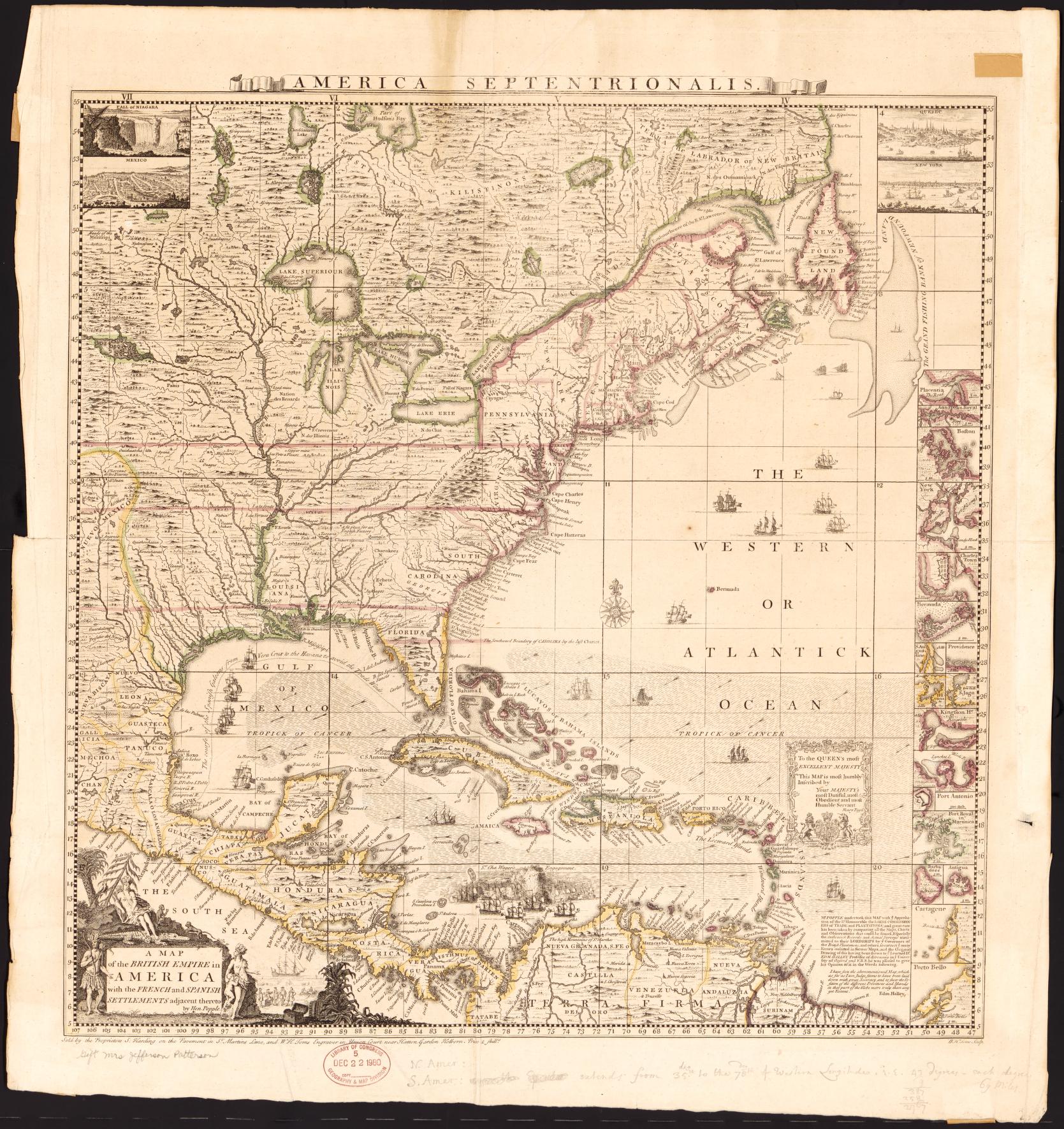
Open the full-size supplied image (new tab) · Examine the original in the Library of Congress viewer (new tab)
The original image could not load. The complete descriptive equivalent below contains the source features needed for all three parts.
These detail views display portions of the same image. No labels or colors have been added. The supplied reproduction has limited resolution; the descriptive equivalent below makes the relevant wording accessible.
The title identifies the main subject as the British Empire in America and describes French and Spanish settlements as adjacent thereto. The map includes eastern North America, the Caribbean, Central America, and part of northern South America. It names British mainland colonies along the Atlantic side of North America, including Virginia and Maryland around Chesapeake Bay. It also names French and Spanish places, depicts rivers and lakes, and includes small inset views and plans of settlements and ports, including New York and Quebec.
For these questions, you can analyze the title’s wording and the placement of Virginia and Maryland around Chesapeake Bay. No answer depends on deciphering small lettering or assigning a modern border to a shaded area. These are descriptions of source features, not conclusions about who actually controlled the land.
Original map: public domain. Reproduction of the Library of Congress copy; image supplied for this lab. Image provenance and public-domain record. The supplied image and its descriptive equivalent are included in this site; viewing them does not require an external image service.
A map can accurately record some places while still presenting the world from a particular political viewpoint. Connect a feature to the perspective it conveys.
Identify a cause of settlement near the bay and rivers. The map itself cannot establish the entire cause; bring historical context to the spatial evidence.
Name a nation and an action, then explain how it shows independent power or contested authority. Do not assume Native nations all shared one policy.
(A) Briefly explain how one specific feature of Popple’s 1733 map communicates a British imperial perspective. Use the image or its descriptive equivalent as evidence.
(B) Briefly explain how one development from 1607 to 1733 helps account for the pattern of English settlement around Chesapeake Bay represented on the map.
(C) Briefly explain how one specific Native nation’s diplomacy or resistance from 1607 to 1733 complicates reading the map as proof of uncontested European control.
Your response
Each part stands alone. Give a direct answer, specific evidence, and the connection between them.
Review after drafting
These are examples, not the only defensible answers. T.E.A. is a reasoning routine, not a required sentence count.
A: One feature communicating a British imperial perspective is the map’s title, which makes the British empire its central subject. It names the British Empire in America and describes French and Spanish settlements as adjacent to it. That wording organizes a contested continent around Britain’s imperial presence rather than presenting all political communities on equal terms.
Why this works: The answer explains how a concrete source feature frames the subject. It does not rely on “all maps are biased.”
B: One development explaining English settlement around Chesapeake Bay was the growth of tobacco cultivation for Atlantic export after the 1610s. Planters used navigable rivers feeding the bay to move bulky tobacco crops to ships. Access to those waterways made nearby plantation settlement commercially useful, helping explain the relationship between colonial settlement and the bay shown on the map.
Why this works: The answer supplies a mechanism connecting the economy to a location, instead of treating the map as proof of its own cause.
C: One Native action complicating uncontested European control was the Powhatan attack on English settlements organized by Opechancanough in 1622. Powhatan forces struck multiple settlements as English expansion threatened Native lands, and renewed warfare followed. The ability to organize resistance and disrupt settlement shows that an English colony’s name on a map did not establish secure authority over Native territory.
Why this works: The answer identifies a nation, leader, date, and action, then connects resistance to the limits of the map’s political claims.
T direct answer E specific evidence A explicit connection
A: “It is biased because Popple was British.”
B: “The English settled there because there was water.”
C: “The Indians fought back in Pontiac’s Rebellion.”
Export
Instructions and labels will be bold when rich clipboard copying is supported; your writing will remain unbolded.
Your work will save automatically in this tab for this browser session.
