Congressional caucus
Members of the dominant party’s congressional caucus informally selected a presidential ticket. This concentrated nomination power among national officeholders.
APUSH Period 4 · 1800–1848 · Flagship Exhibit
Democracy, expansion, and removal in the age of Jackson.
How to work this exhibit: encounter the evidence, use the short investigations, and save what you may need for the companion assignment. The exhibit is self-contained; outside links are credits or optional further study.
Companion Assignment · 20 points
This exhibit and the Canvas assignment are designed to work together. Open the assignment in a second tab, then return here. At each checkpoint, you will have enough evidence to complete the next response without turning the exhibit into a scavenger hunt.
The puzzle
Between 1800 and 1848, many states weakened property qualifications for white men. Campaigns and parties made politics more public. At the same time, racial and gender exclusions persisted, Native sovereignty was attacked, and federal and state power expanded over land and people. Keep asking who is included, who is excluded, and who gets to decide.
The first change to test is the expansion of voting for many white men. The table also makes the limits visible.
Core investigation · about 10–12 minutes
There was no single national voting rule. State constitutions and statutes decided who qualified. “Jacksonian democracy” therefore describes a real expansion, but not a universal one. Property barriers often weakened while racial and gender boundaries remained or hardened.
Research note: These are rounded historical snapshots for comparison, not a claim that every state changed in the same election year. “White” and “free white male” are retained because they describe historical legal categories. The comparison follows qualifications for voting for the federal House; a rule limited to a state senate is not counted in the Property column.
YES means that a rule or boundary appears in the snapshot. It does not mean that every voter faced the same route or that the rule was universal.
NO means that no rule or boundary is identified in this snapshot. A blank second line under NO means no additional qualifier is being foregrounded; it is not a claim that no other law mattered. NO does not mean universal suffrage.
Alternative means one of two qualifying routes described in the source. The label appears only when the source describes the routes as alternatives; a tax rule by itself is labeled tax qualification.
Racial boundary separates a categorical racial exclusion from a higher racialized property barrier, such as New York’s higher property rule for Black men. Other citizenship, residence, gender, and status limits remain in the caveat column and are not treated as identical to racial exclusion.
Statehood note: The table includes all 30 states admitted by the end of 1848. “Not a state yet” means the territory did not yet have a state electorate in that snapshot; it does not describe territorial voting rules. The comparison draws on Richard Keyssar’s compiled chronology and institutional state-election histories, with the South Carolina 1810 transition checked against the Tufts A New Nation Votes state history.
Before scanning the whole table, choose three comparisons that help you notice change, difference, and limits. Ask what changed, who benefited, and what boundary remained.
This is a wide comparison table. On a small screen, swipe horizontally; use the checkboxes and the comparison panel below to keep three rows together.
| Use | State | Snapshot | Property | Tax | Racial boundary | Other qualification / status note |
|---|---|---|---|---|---|---|
| Connecticut | 1800 | YES | NO | NO | Male voters | |
| Connecticut | 1828 | YESproperty route | YESalternative | YESexclusion | Militia alternative added in 1818; racial restriction | |
| Connecticut | 1848 | NOdropped in 1845 | YEStax or militia routes | YESexclusion | Tax or militia route; racial restriction | |
| Delaware | 1800 | NOended in 1792 | NO | YESexclusion | Free men | |
| Delaware | 1828 | NO | NO | YESexclusion | Free white male restriction | |
| Delaware | 1848 | NO | NO | YESexclusion | Free white male restriction | |
| Georgia | 1800 | YESproperty route | YESalternative | YESexclusion | White male restriction | |
| Georgia | 1828 | YES | YES | YESexclusion | White male qualification | |
| Georgia | 1848 | NO | NO | YESexclusion | White male qualification | |
| Kentucky | 1800 | NO | NO | YESexclusion | Free white male qualification | |
| Kentucky | 1828 | NO | NO | YESexclusion | Free white male qualification | |
| Kentucky | 1848 | NO | NO | YESexclusion | Free white male qualification | |
| Maryland | 1800 | YES | NO | NO | Free men | |
| Maryland | 1828 | NOdropped for state elections in 1801 | NO | YESexclusion | Free white male qualification | |
| Maryland | 1848 | NO | NO | YESexclusion | Free white male qualification | |
| Massachusetts | 1800 | YES | NO | NO | Male voters | |
| Massachusetts | 1828 | NOended in 1821 | NO | NO | Male voters | |
| Massachusetts | 1848 | NO | NO | NO | Male voters | |
| New Hampshire | 1800 | NO | YES | NO | Male voters | |
| New Hampshire | 1828 | NO | YES | NO | Residency rules | |
| New Hampshire | 1848 | NO | YES | NO | Male voters; residency rules | |
| New Jersey | 1800 | YES | NO | NO | Some property-owning women could vote until 1807 | |
| New Jersey | 1828 | YESrequirement remains | YESalternative | YESexclusion | Property qualification remained; tax alternative added in 1807 | |
| New Jersey | 1848 | NOended in 1844 | NO | YESexclusion | White male qualification | |
| New York | 1800 | YES | YES | NO | Free male voters | |
| New York | 1828 | NOended for white men in 1821 | NO | YEShigher property bar | Higher property rule for Black men | |
| New York | 1848 | NO | NO | YEShigher property bar | Higher property rule for Black men | |
| North Carolina | 1800 | NO | YES | NO | Free men; property rule applied to the state Senate | |
| North Carolina | 1828 | NO | YES | NO | Free male voters; 50-acre rule applied to the state Senate | |
| North Carolina | 1848 | NO | YES | YESexclusion | Free Black men barred in 1835; 50-acre rule applied to the state Senate | |
| Ohio | 1800 | Not a state yet | Not a state yet | Not a state yet | Not a state yet | |
| Ohio | 1828 | NO | YES | YESexclusion | Free white male qualification; tax qualification remained | |
| Ohio | 1848 | NO | YES | YESexclusion | Free white male qualification; tax qualification remained until 1851 | |
| Pennsylvania | 1800 | NO | YES | NO | Free men | |
| Pennsylvania | 1828 | NO | YES | NO | Racial restriction adopted in 1838 | |
| Pennsylvania | 1848 | NO | YES | YESexclusion | White male qualification | |
| Rhode Island | 1800 | YES | NO | NO | Property-holding voters | |
| Rhode Island | 1828 | YES | NO | NO | Property-holding voters | |
| Rhode Island | 1848 | YESrequirement | NO | NO | Native-born property exemption in 1842 | |
| South Carolina | 1800 | YESproperty route | YEStax alternative | YESexclusion | Tax alternative; white male restriction | |
| South Carolina | 1828 | NOdropped in 1810 | NO | YESexclusion | Six-month residency; white male restriction | |
| South Carolina | 1848 | NO | NO | YESexclusion | Six-month residency; white male restriction | |
| Tennessee | 1800 | YESproperty/residency routes | NO | NO | Property/residency alternatives | |
| Tennessee | 1828 | YESproperty/residency routes | NO | NO | Property/residency alternatives | |
| Tennessee | 1848 | NOended in 1834 | NO | YESexclusion | White male qualification | |
| Virginia | 1800 | YES | NO | YESexclusion | White male restriction | |
| Virginia | 1828 | YES | NO | YESexclusion | White male restriction | |
| Virginia | 1848 | YES | NO | YESexclusion | White male restriction | |
| Vermont | 1800 | NO | NO | NO | Free male inhabitants; one-year residence | |
| Vermont | 1828 | NO | NO | NO | Free male inhabitants; one-year residence | |
| Vermont | 1848 | NO | NO | NO | Free male inhabitants; one-year residence | |
| Louisiana | 1800 | Not a state yet | Not a state yet | Not a state yet | Not a state yet | |
| Louisiana | 1828 | NO | YESalternative | YESexclusion | Free white male citizens, age 21+; one-year county residence; tax or federal-land purchase alternative | |
| Louisiana | 1848 | NO | YES | YESexclusion | 1845 constitution retained the tax/land-purchase framework and extended it to elections generally | |
| Indiana | 1800 | Not a state yet | Not a state yet | Not a state yet | Not a state yet | |
| Indiana | 1828 | NO | NO | YESexclusion | White male citizens/residents; residence requirement | |
| Indiana | 1848 | NO | NO | YESexclusion | White male citizens/residents; residence requirement | |
| Mississippi | 1800 | Not a state yet | Not a state yet | Not a state yet | Not a state yet | |
| Mississippi | 1828 | NO | NO | YESexclusion | Earlier property/tax qualifications had been removed by 1826; white male suffrage remained | |
| Mississippi | 1848 | NO | NO | YESexclusion | White male suffrage; racial exclusion remained | |
| Illinois | 1800 | Not a state yet | Not a state yet | Not a state yet | Not a state yet | |
| Illinois | 1828 | NO | NO | YESexclusion | White male inhabitants over 21; six-month residence | |
| Illinois | 1848 | NO | NO | YESexclusion | White male citizens over 21; one-year residence under the 1848 constitution | |
| Alabama | 1800 | Not a state yet | Not a state yet | Not a state yet | Not a state yet | |
| Alabama | 1828 | NO | NO | YESexclusion | White male citizens, age 21+; state and county residence requirements | |
| Alabama | 1848 | NO | NO | YESexclusion | White male citizens, age 21+; state and county residence requirements | |
| Maine | 1800 | Not a state yet | Not a state yet | Not a state yet | Not a state yet | |
| Maine | 1828 | NO | NO | NO | Male U.S. citizens age 21+; three-month residence; paupers, persons under guardianship, and Indians not taxed excluded | |
| Maine | 1848 | NO | NO | NO | Male U.S. citizens age 21+; residence requirement; paupers, persons under guardianship, and Indians not taxed excluded | |
| Missouri | 1800 | Not a state yet | Not a state yet | Not a state yet | Not a state yet | |
| Missouri | 1828 | NO | NO | YESexclusion | White male citizens over 21; residence requirement | |
| Missouri | 1848 | NO | NO | YESexclusion | White male citizens over 21; residence requirement | |
| Arkansas | 1800 | Not a state yet | Not a state yet | Not a state yet | Not a state yet | |
| Arkansas | 1828 | Not a state yet | Not a state yet | Not a state yet | Not a state yet | |
| Arkansas | 1848 | NO | NO | YESexclusion | White male citizens over 21; residence requirement | |
| Michigan | 1800 | Not a state yet | Not a state yet | Not a state yet | Not a state yet | |
| Michigan | 1828 | Not a state yet | Not a state yet | Not a state yet | Not a state yet | |
| Michigan | 1848 | NO | NO | YESexclusion | White male citizens over 21; residence requirement | |
| Florida | 1800 | Not a state yet | Not a state yet | Not a state yet | Not a state yet | |
| Florida | 1828 | Not a state yet | Not a state yet | Not a state yet | Not a state yet | |
| Florida | 1848 | NO | NO | YESexclusion | White male citizens over 21; residence requirement | |
| Texas | 1800 | Not a state yet | Not a state yet | Not a state yet | Not a state yet | |
| Texas | 1828 | Not a state yet | Not a state yet | Not a state yet | Not a state yet | |
| Texas | 1848 | NO | NO | YESexclusion | White male citizens and certain white male declarants; residence requirement | |
| Iowa | 1800 | Not a state yet | Not a state yet | Not a state yet | Not a state yet | |
| Iowa | 1828 | Not a state yet | Not a state yet | Not a state yet | Not a state yet | |
| Iowa | 1848 | NO | NO | YESexclusion | White male citizens over 21; residence requirement | |
| Wisconsin | 1800 | Not a state yet | Not a state yet | Not a state yet | Not a state yet | |
| Wisconsin | 1828 | Not a state yet | Not a state yet | Not a state yet | Not a state yet | |
| Wisconsin | 1848 | NO | NO | YESexclusion | White male citizens and certain white male foreign-born declarants; one-year state residence plus local residence |
Showing all 90 rows.
Choose up to three rows that give you something meaningful to compare across time, place, or qualification. The categories can overlap; explain why these cases belong together and what your comparison makes visible.
No rows selected.
A larger white male electorate changed how parties selected candidates, organized voters, and claimed presidential legitimacy—but it did not make politics free of insiders.
Core investigation · about 8–10 minutes
The voting table shows a crucial change: many states weakened property barriers for white men. That change created a larger electorate that ambitious politicians had to reach, organize, and persuade. Political authority increasingly depended on public campaigning and party organization, not only on personal standing among established statesmen.
That shift was not a clean march toward popular control. The old congressional caucus system gave way to conventions and party networks, but delegates, editors, officeholders, and donors still shaped who could become a candidate. “Mass politics” names a new political style and machinery—not universal democracy.
Working question
Compare the formal route to nomination with the people political leaders claimed to represent.
Members of the dominant party’s congressional caucus informally selected a presidential ticket. This concentrated nomination power among national officeholders.
No candidate won an Electoral College majority, so the House chose John Quincy Adams. The result exposed how a “people’s choice” could be redirected through constitutional procedure and congressional bargaining.
Anti-Masonic, National Republican, and Democratic organizers used party conventions to select candidates and coordinate platforms. Delegates broadened participation beyond a small congressional caucus, while party insiders still controlled access.
Parties used rallies, newspapers, symbols, songs, and locally organized committees to mobilize voters. Campaigning became a recurring public performance of who “the people” were.
The 1824 election exposed a tension between the constitutional machinery of presidential selection and a growing expectation that voters should determine the result. Read the constitutional rule alongside the official electoral tally.
“The person having the greatest Number of Votes shall be the President, if such Number be a Majority of the whole Number of Electors appointed; and if no person have such Majority, then from the persons having the highest Numbers not exceeding three on the List of those voted for as President, the House of Representatives shall choose immediately, by Ballot, the President.”
Twelfth Amendment, ratified 1804; the rule used in the 1824 contingent election| Candidate | Electoral votes | Result |
|---|---|---|
| Andrew Jackson | 99 | Plurality, not majority |
| John Quincy Adams | 84 | Advanced to House |
| William H. Crawford | 41 | Advanced to House |
| Henry Clay | 37 | Finished fourth |
Read the evidence: Jackson led the tally but did not receive a majority, so the House selected Adams from the three highest candidates. The constitutional procedure was legal; the political conflict came from a widening expectation that popular support should control who became president.
Investigate: What does the amendment authorize, and what does the tally reveal about why the result could feel undemocratic? How did the controversy help make caucuses, conventions, and party organization central to the Second Party System?
Source record: Twelfth Amendment; National Archives, 1824 Electoral College results. The required amendment and tally are reproduced above.
Select the developments that made politics more public and/or the limit that remained. The first three describe changes in political machinery; the last names a continuing limit.
Jacksonian Democracy joined a populist claim about ordinary citizens to an expansive claim about what the president could decide.
Core investigation · about 8–10 minutes
Jackson’s 1832 veto message belongs inside the new mass-politics system. He wrote to a larger electorate and framed the Bank as a symbol of “artificial” privilege. His argument was not simply that the Bank was economically unfair. He claimed that the president could judge the bill’s constitutionality for himself, even after Congress passed it.
Audience and moment: Jackson sent the message to the Senate after Congress passed the recharter bill, during his 1832 reelection campaign. Read its appeal to ordinary citizens alongside its claim that the president could make an independent constitutional judgment.
Read for two claims at once: Who does Jackson define as “the people”? What kind of constitutional authority does he claim for the presidency?
Read the source in two passes. First, notice Jackson’s longer argument and the assumptions he carries into it. Then return to the highlighted phrases and decide how he connects “the people” to presidential power.
“The rich and powerful too often bend the acts of government to their selfish purposes. Distinctions in society will always exist under every just government. Equality of talents, of education, or of wealth cannot be produced by human institutions. In the full enjoyment of the gifts of Heaven and the fruits of superior industry, economy, and virtue, every man is equally entitled to protection by law; but when the laws undertake to add to these natural and just advantages artificial distinctions, to grant titles, gratuities, and exclusive privileges, to make the rich richer and the potent more powerful, the humble members of society—the farmers, mechanics, and laborers—who have neither the time nor the means of securing like favors to themselves, have a right to complain of the injustice of their Government.”
Jackson distinguishes between unequal wealth that he calls “natural” and unequal power created by law. He presents farmers, mechanics, and laborers as the moral center of “the people,” while casting the Bank as an artificial privilege.
Jackson now applies his privilege argument to the bill before him and makes constitutional disagreement a reason to veto it:
“The bill before me is a measure of this character. It is not necessary to inquire whether the provisions of the bill are constitutional or not. It is enough that it is contrary to the Constitution as I understand it.”
The repetition matters: Jackson makes economic fairness and constitutional judgment part of the same argument. He does not merely say that Congress made a bad policy choice. He claims the presidency may act on the president’s own constitutional understanding.
“The opinion of the judges has no more authority over Congress than the opinion of Congress has over the judges, and on that point the President is independent of both.”
“The authority of the Supreme Court must not, therefore, be permitted to control the Congress or the Executive when acting in their legislative capacities, but to have only such influence as the force of their reasoning may deserve.”
Jackson’s claim is unusually broad. He presents each branch as responsible for its own constitutional judgment, but the veto makes that principle especially powerful for the president.
Source record: Yale Avalon Project transcription; National Archives record. Jackson sent this message to the Senate after Congress passed the recharter bill; the embedded excerpts preserve the evidence needed for the investigation.
Select the lenses supported by the passage, then make the connection explicit.
Jacksonian democracy expanded political participation for many white men while the United States asserted power over Native nations. Follow the sources in sequence to test the gap between democratic language and sovereign power.
Core investigation · about 15–18 minutes
Read all three sources in order. Each source changes the question you should ask of the next one.
1 · Read first: the administration’s claim
Jackson addressed Congress after the Indian Removal Act authorized negotiated exchanges. Read beyond the sentence that names state growth: his message moves among federal-state conflict, white settlement, Native “protection,” and assumptions about civilization.
“It gives me pleasure to announce to Congress that the benevolent policy of the Government, steadily pursued for nearly thirty years, in relation to the removal of the Indians beyond the white settlements is approaching to a happy consummation.”
“The consequences of a speedy removal will be important to the United States, to individual States, and to the Indians themselves. The pecuniary advantages which it promises to the Government are the least of its recommendations. It puts an end to all possible danger of collision between the authorities of the General and State Governments on account of the Indians.”
“By opening the whole territory between Tennessee on the north and Louisiana on the south to the settlement of the whites it will incalculably strengthen the southwestern frontier… It will relieve the whole State of Mississippi and the western part of Alabama of Indian occupancy, and enable those States to advance rapidly in population, wealth, and power.”
“What good man would prefer a country covered with forests and ranged by a few thousand savages to our extensive Republic, studded with cities, towns, and prosperous farms… filled with all the blessings of liberty, civilization and religion?”
“Can it be cruel in this Government when, by events which it can not control, the Indian is made discontented in his ancient home to purchase his lands, to give him a new and extensive territory, to pay the expense of his removal, and support him a year in his new abode?”
Jackson calls removal benevolent while repeatedly measuring its benefits through white settlement, state strength, and federal-state peace. He also presents coercive circumstances as if they were choices Native people would welcome. Students should identify both the policy problem Jackson acknowledges and the political community he treats as the republic’s rightful future.
Investigate: Which parts of Jackson’s argument are about land, which are about government authority, and which are about “civilization”? Which words make pressure sound like consent?
Source record: National Archives transcript and context. The required evidence is reproduced above.
2 · Read second: a nation’s argument
The memorial addresses Congress as an organized political body. Read the full sequence as an argument about history, law, political identity, and the experience of pressure—not merely as a statement that Cherokee people loved their homeland.
“We are now placed between the laws of the State of Georgia and the laws of the United States.”
“The State of Georgia has assumed the power to extend her laws over us, and to take from us the right of self-government.”
“This right of inheritance we have never ceded, nor ever forfeited.”
“We do solemnly protest against being forced to leave it, either by direct or indirect measures.”
“We wish to remain on the land of our fathers, and to enjoy the blessings of our own institutions.”
The memorial builds its case through several kinds of evidence: the continuity of a people, inherited occupation, treaty relationships, political institutions, and the difference between direct force and indirect pressure. Its authors are not asking to be included as individuals in Georgia; they are asserting the continuing authority of a nation.
Investigate: Mark one legal claim, one political claim, one territorial claim, and one claim about coercion. How does the memorial define a “people” differently from Jackson’s message?
Source record: U.S. House history and archives; National Archives / DocsTeach transcript. The required evidence is reproduced above.
3 · Read third: the legal boundary
The Court considered whether Georgia could punish a missionary for living in Cherokee territory without a state license. Read the majority’s reasoning before focusing on its famous conclusion.
“The very term ‘nation,’ so generally applied to them, means ‘a people distinct from others.’”
“The very fact of repeated treaties with them recognises it, and the settled doctrine of the law of nations is that a weaker power does not surrender its independence—its right to self-government—by associating with a stronger and taking its protection.”
“The Cherokee nation, then, is a distinct community, occupying its own territory, with boundaries accurately described, in which the laws of Georgia can have no force.”
“The acts of the Legislature of Georgia interfere forcibly with the relations established between the United States and the Cherokee Nation… and recognise the preexisting power of the Nation to govern itself.”
“The forcible seizure and abduction of the plaintiff in error… is also a violation of the acts which authorize the Chief Magistrate to exercise his authority.”
The opinion recognizes Native political existence through treaties, territory, self-government, and federal authority. It also reveals a limit in the legal framework: the Court can identify what Georgia may not do, but the ruling cannot by itself guarantee that political officials will enforce that boundary.
Investigate: Which sentence most clearly recognizes Cherokee sovereignty? Which sentence shows the role of treaties? What does the opinion establish, and what remains outside the Court’s control?
Source record: Cornell Legal Information Institute transcription. The required holding and surrounding reasoning are reproduced above.
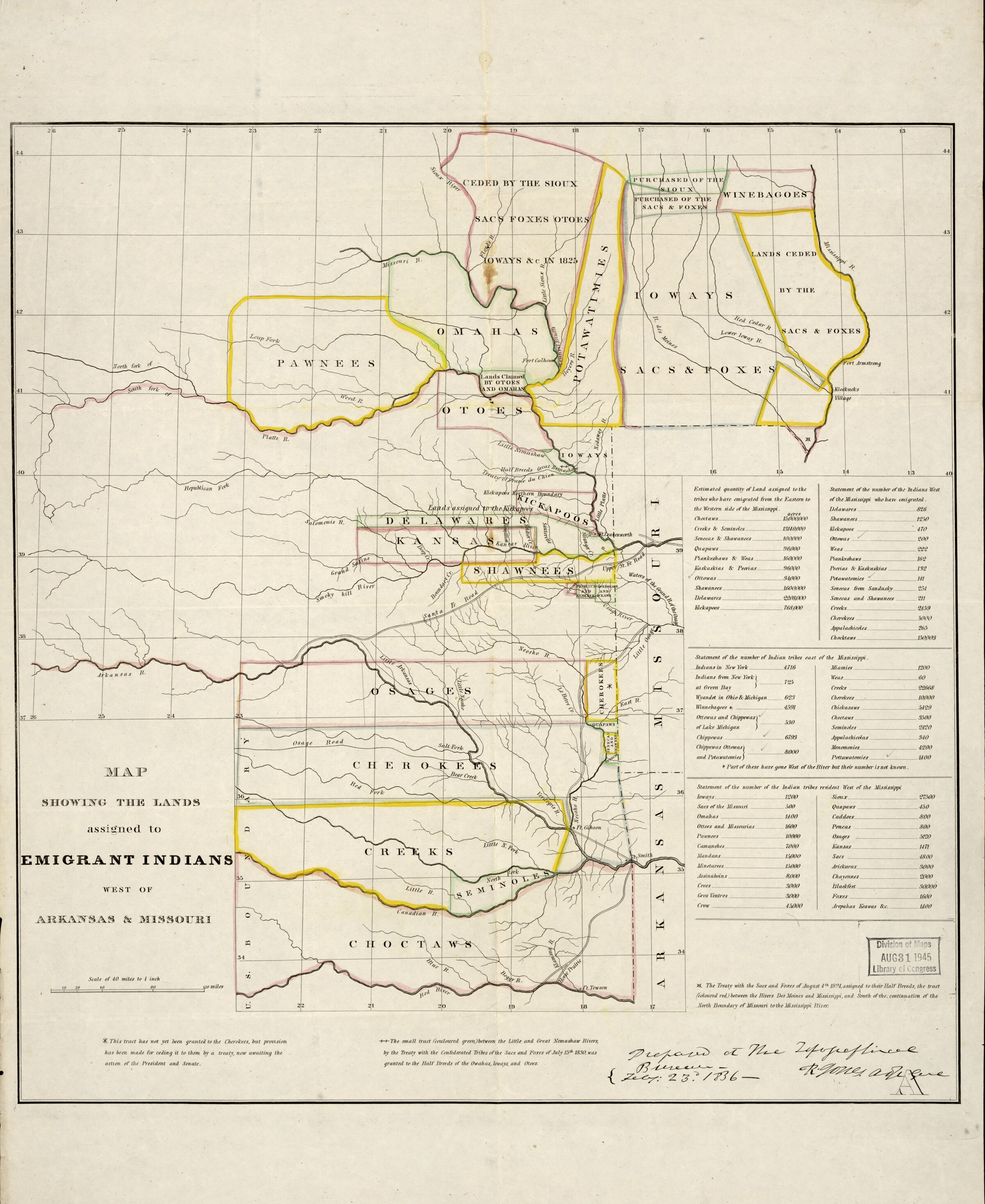
Orient yourself: the Mississippi River appears along the right edge of the map, helping you locate the assigned western lands in relation to the eastern United States.
The map places Native groups and assigned lands west of Arkansas and Missouri, while also marking rivers, roads, military posts, and the expanding U.S. geographic frame. It helps show the spatial destination of removal and the administrative perspective of the government. It cannot show whether land cessions were voluntary, coerced, contested, or enforceable.
Choose the source that best answers each question. More than one answer can be defensible if your explanation uses a specific passage; the goal is to compare the claims, not to guess a single key.
At Seneca Falls, reformers used the Declaration of Independence's language to expose a democratic boundary the era's celebrations could not resolve.
Focused comparison · about 8–10 minutes
“We hold these truths to be self-evident, that all men are created equal, that they are endowed by their Creator with certain unalienable Rights, that among these are Life, Liberty and the pursuit of Happiness.—That to secure these rights, Governments are instituted among Men, deriving their just powers from the consent of the governed.”
This language linked legitimate government to rights and consent. Its historical force came partly from the gap between the claim and the political order in which it was written.
Source record: National Archives transcription. The relevant language is reproduced above.
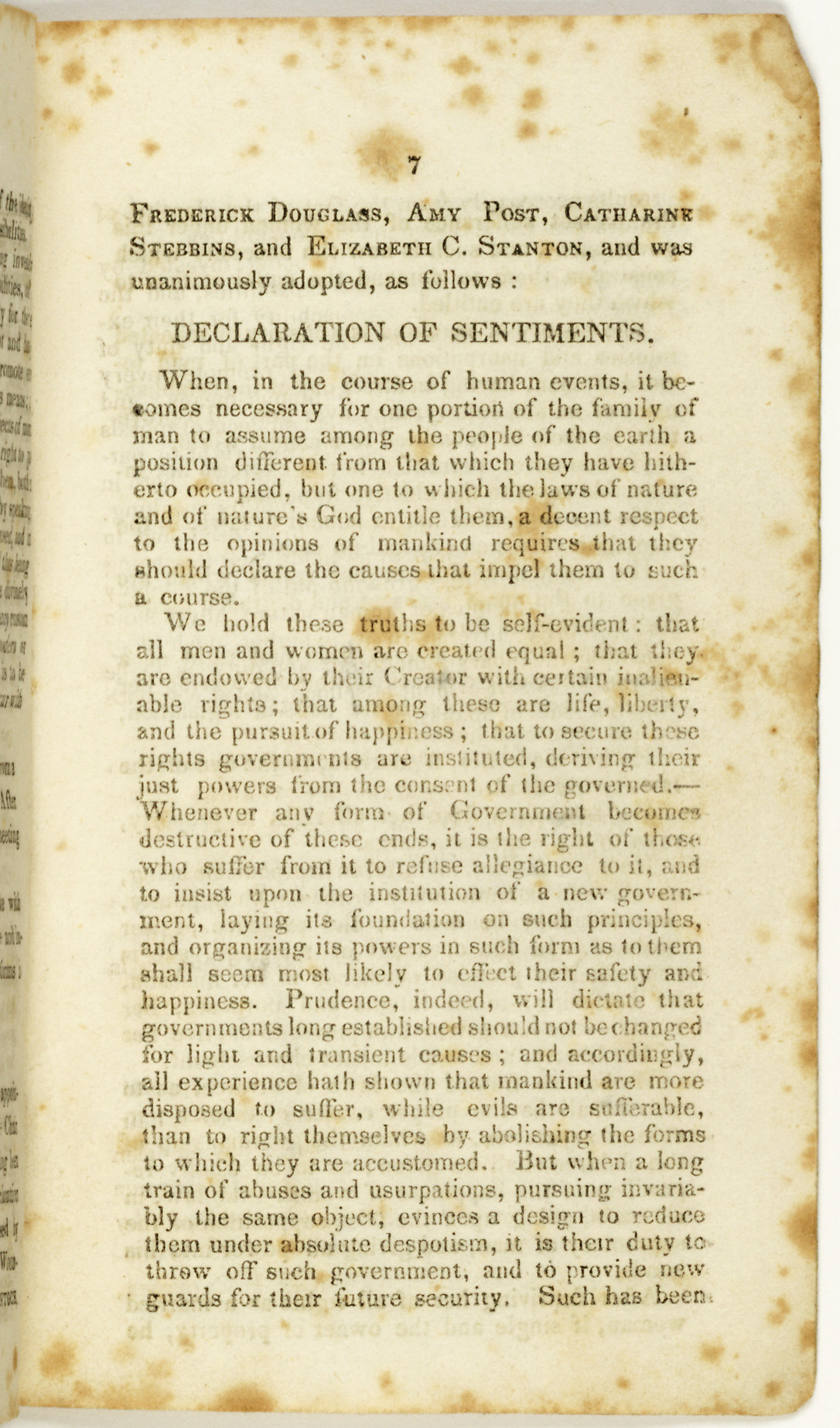
“We hold these truths to be self-evident: that all men and women are created equal.”
“He has never permitted her to exercise her inalienable right to the elective franchise.”
“He has compelled her to submit to laws, in the formation of which she had no voice.”
“He has withheld from her rights which are given to the most ignorant and degraded men—both natives and foreigners.”
The reformers changed “all men” to “all men and women” and turned the founding grievance structure toward women’s legal and political subordination. The racialized comparison in the grievance also reveals how the document argued within a wider hierarchy of citizenship; use it as evidence of the authors’ claim, not as a neutral description of the men it names.
Source record: Library of Congress proceedings; National Park Service transcription. The required excerpts and facsimile are reproduced above.
Connect the rooms: the voting table shows that racial boundaries and women’s exclusion operated through different laws and political categories. Use both kinds of evidence without treating every exclusion as identical.
Select the tags that describe the Declaration of Sentiments, then complete the sentence.
The exhibit has given you the evidence. The companion assignment asks you to explain the pattern.
Handoff · about 5 minutes
Return to the central question
Use the exhibit to make a claim about how democracy expanded and narrowed between 1800 and 1848.
Observation: name a specific state-year entry, phrase, ruling, or map feature. Claim: explain the pattern it supports. Complication: identify a limit or a source that makes the claim more precise.
Your saved investigations persist for this browser session only; they are not sent anywhere.
No investigation entries saved yet.
Next step
Use these notes when your teacher opens the companion assignment. Turn them into a defensible historical argument; the assignment—not this final room—will ask you to synthesize the evidence.
Ready to submit?
The exhibit is your evidence space; Canvas is the place to submit the 20-point companion assignment.