How did Chesapeake labor shift from heavy reliance on indentured servitude toward racial, hereditary chattel slavery—and how did slavery differ elsewhere?
From a term of service to a status inherited at birth. Investigate why Chesapeake planters increasingly relied on slavery, how law made racial hierarchy more durable, and why the resulting system did not look the same in every colony.
Chattel slavery treated people as property that could be bought, sold, and inherited. Its racial and hereditary rules developed over time. Servitude continued alongside it; this was an uneven transition, not a complete replacement in one year.
Your route: Investigate the promise of service, trace changing legal status, weigh Bacon’s Rebellion, and compare regional settings. Pause at each section’s main question and record your responses in the companion assignment. Use reading aids as needed; the Declaration and extended timeline exploration offer deeper investigation.
Reading historical language
Documents retain historical racism, the treatment of people as property, and descriptions of violence. Those are the authors’ words, not this exhibit’s descriptions. Brackets mark clarifications or damaged text; ellipses mark omissions. You can complete the investigation here without opening outside links.
01 · Labor under contract
Why did colonists initially rely on indentured servants?
Early Chesapeake tobacco growers needed workers. Many English migrants lacked passage money; a limited term of service connected migration to labor demand. Masters gained years of work, while servants faced coercion and uncertain prospects after service.
Indentured service had an endpoint in principle, unlike hereditary chattel slavery. But disease, punishment, extensions of service, and restricted access to land could undermine servants’ hopes of independence. Not all recruitment was voluntary.
Why leave England? In the late sixteenth and early seventeenth centuries, population growth, poverty, and limited work opportunities put pressure on many English households. People hoping to improve their circumstances could lack the money for Atlantic passage. Indentured service offered passage in exchange for years of labor, but recruitment was not always voluntary and English conditions varied over time. Historical context (opens in a new tab).
Read Hammond’s recruitment promise alongside Frethorne’s experience. Ask why service could seem worthwhile and what made its outcome uncertain.
Recruitment literature · 1656 · John Hammond
The promise: service as a path to independence
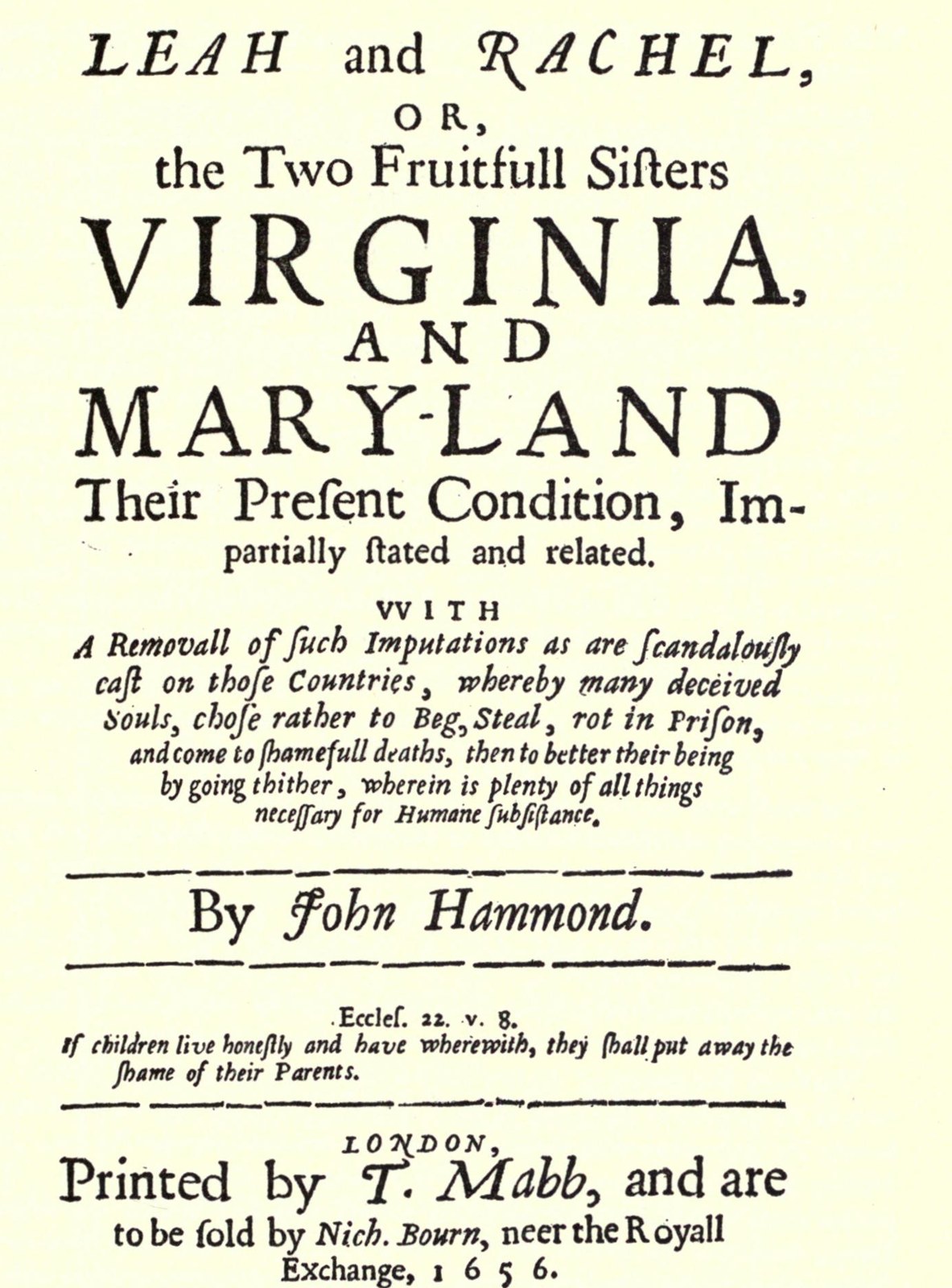
John Hammond’s Leah and Rachel is a promotional pamphlet published in London in 1656 about Virginia and Maryland. These passages describe servants’ prospects in Virginia. Frethorne’s letter below dates from 1623; it is not a response to this later pamphlet.
Reading focus: What future does Hammond offer, and what conditions does he attach to it?
From the collections
Leah and Rachel · 1656
Hammond’s original title page presents Virginia and Maryland as places of opportunity. Facsimile reproduced in the 1907 Church catalogue; detail from the catalogue page.
The usuall allowance for servants is (besides their charge of passage defrayed) at their expiration, a years provision of corne, dubble apparrell, tooles necessary, and land according to the custome of the Country, which is an old delusion, for there is no land accustomary due to the servant, but to the Master, and therefore that servant is unwise that will not dash out that custom in his covenant, and make that due of land absolutely his own, which although at the present, not of so great consequence; yet in few years will be of much worth, as I shall hereafter make manifest.
[…]
Those Servants that will be industrious may in their time of service gain a competent estate before their Freedomes, which is usually done by many, and they gaine esteem and assistance that appear so industrious: There is no Master almost but will allow his Servant a parcell of clear ground to plant some Tobacco in for himself, which he may husband at those many idle times he hath allowed him and not prejudice, but rejoyce his Master to see it, which in time of Shipping he may lay out for commodities, and in Summer sell them again with advantage, and get a Sow-Pig or two, which any body almost will give him, and his Master suffer him to keep them with his own, which will be no charge to his Master, and with one years increase of them may purchase a Cow Calf or two, and by that time he is for himself; he may have Cattel, Hogs and Tobacco of his own, and come to live gallantly; but this must be gained (as I said) by Industry and affability, not by sloath nor churlish behaviour.
Two noncontiguous complete paragraphs; omitted material marked. Long s standardized to s; line-break hyphenation joined; wording otherwise follows the EEBO-TCP transcription A87050, reproduced from the British Library original (Wing H620; Thomason E865_6; ESTC R207623). Documentary record and transcription (opens in a new tab).
Terms in this passage
Expiration: the end of a term of service.
Covenant: an agreement or contract.
Estate: property or resources.
Husband: cultivate or manage.
Affability: a friendly manner.
Sloath: idleness; modern spelling: sloth.
Churlish: rude or unfriendly.
Modern-English version · click to read
Editorial modern-English paraphrase, not a historical quotation. This reading aid follows the excerpt above; omissions remain marked. Dated or demeaning labels are replaced with respectful terms. Return to the original wording when interpreting the source.
The usual allowance for servants includes the cost of their passage. At the end of service, they receive a year’s supply of corn, two sets of clothing, necessary tools, and supposedly land according to local custom. But that supposed right to land is an old deception: customary land is due to the master, not the servant. A servant should therefore remove that vague provision from the agreement and explicitly secure the land for themselves. Although land may not seem very important immediately, it will become valuable in a few years, as I will explain later.
[…]
Hardworking servants may acquire substantial resources before their service ends, as many do, and their effort wins respect and assistance. Almost every master, I claim, will let a servant plant some tobacco for themselves on a cleared plot. The servant can cultivate it during permitted spare time without interfering with the master’s work; the master will be pleased to see it. When ships arrive, the servant can exchange the tobacco for goods and resell those goods in summer at a profit. The servant might obtain young pigs, which people may give them, and keep them alongside the master’s animals without expense to the master. After a year of breeding, the pigs may pay for young cattle. By the time the servant is independent, they may own cattle, pigs, and tobacco and live comfortably. But I say this requires hard work and a friendly manner, rather than idleness or rudeness.
Richard Frethorne · 1623 · Virginia
A servant asks to be redeemed
Richard Frethorne writes to his parents from a distressed settlement after the 1622 conflict. He wants help. Read his description as evidence of his circumstances and persuasive purpose, rather than a statistical account of every servant’s life.
Reading focus: Notice how a description becomes a request. Distinguish Frethorne’s own circumstances from a general claim.
LOVING AND KIND FATHER AND MOTHER:
My most humble duty remembered to you, hoping in god of your good health, as I myself am at the making hereof. This is to let you understand that I your child am in a most heavy case by reason of the country, [which] is such that it causeth much sickness, [such] as the scurvy and the bloody flux and diverse other diseases, which maketh the body very poor and weak. And when we are sick there is nothing to comfort us; for since I came out of the ship I never ate anything but peas, and loblollie (that is, water gruel). As for deer or venison I never saw any since I came into this land. There is indeed some fowl, but we are not allowed to go and get it, but must work hard both early and late for a mess of water gruel and a mouthful of bread and beef. A mouthful of bread for a penny loaf must serve for four men which is most pitiful.
[…]
And he [Goodman Jackson] much marvelled that you would send me a servant to the Company; he saith I had been better knocked on the head. And indeed so I find it now, to my great grief and misery; and [I] saith that if you love me you will redeem me suddenly, for which I do entreat and beg. And if you cannot get the merchants to redeem me for some little money, then for God’s sake get a gathering or entreat some good folks to lay out some little sum of money in meal and cheese and butter and beef. Any eating meat will yield great profit.
Two separated passages; omissions and the transcription’s bracketed glosses retained. [Goodman Jackson] is an added editorial identification of the man named earlier in the letter. Read the documentary transcription (opens in a new tab).
Terms in this passage
Scurvy: an illness caused by too little vitamin C.
Bloody flux: a historical name for dysentery, a serious intestinal illness.
Loblollie: thin porridge or gruel.
Mess: a serving of food.
Redeem: pay to release someone from a service obligation.
Meal: ground grain used as food.
Modern-English version · click to read
Editorial modern-English paraphrase, not a historical quotation. This reading aid follows the excerpt above; omissions remain marked. Dated or demeaning labels are replaced with respectful terms. Return to the original wording when interpreting the source.
Dear loving father and mother,
I respectfully send my greetings, hoping that you are in good health, as I am while writing. I want you to understand that I am in great distress. Conditions here cause much illness, including scurvy, dysentery, and other diseases that make people weak. When we are sick, there is nothing to comfort us. Since leaving the ship, I have eaten only peas and thin porridge. I have seen no deer meat. There are birds here, but we are not permitted to hunt them. Instead, we must work hard from early morning until late for a serving of watery porridge and a little bread and beef. A small loaf costing a penny must serve four men, which is deeply distressing.
[…]
Goodman Jackson was astonished that you would send me to serve the Company. He said that I would have been better off dead. In my grief and misery, I now feel the same. If you love me, please pay to release me immediately; I urgently beg you. If you cannot persuade the merchants to release me for a small payment, please collect donations or ask kind people to spend a little money on grain, cheese, butter, and beef. Food sent here could be sold at a good profit.
02 · Conditions changed. Colonists made choices.
Why did labor shift—and how did slavery become racial and hereditary?
Planters’ changing incentives help explain the expansion of slavery. Colonial choices about status help explain its form. Read the laws as steps in constructing a system—not simply descriptions of an already fixed racial order.
What grounds for freedom appear in Key’s case, and what happens to those possibilities in the later laws? Read the legal sequence before building your explanation.
Demand and resources
Tobacco production created continuing demand. Planters with capital could invest in expensive lifetime labor; smaller producers faced different constraints. Plantation growth depended on claims to Indigenous land, not an empty landscape.
Migration and survival
As English opportunities and migration patterns changed, servant supply became less dependable. Improving Chesapeake life expectancy could increase the years of labor an enslaver expected to extract. These conditions varied by decade and did not guarantee survival.
Atlantic connections
Expanding English slave trading increased access to captive Africans. The Royal African Company’s 1672 charter and later widening of English participation mattered, without instantly creating unlimited supply. Caribbean commerce and several ocean routes linked mainland demand to forced migration.
Power and legal choices
Land access and political favoritism produced conflict. Elites could respond by shaping labor rules and unequal rights. Racial hierarchy was constructed and reinforced through decisions, rather than an inevitable result of growing tobacco.
Historical context: Indentured Servants in Colonial Virginia (opens in a new tab); interpretive guidance from Ira Berlin and Peter Kolchin, identified in the source register below. Historians debate the timing and relative weight of these developments; some elites adopted slavery earlier than a simple post-1676 story allows.
Assembly committee report · 1656 · Virginia
Elizabeth Key presses a claim to freedom
An Assembly committee considers Elizabeth Key’s petition for freedom in 1656. The document records officials’ reasoning about her claim, rather than her own words. Pay attention to both their reasons and the limits they place on this report.
Reading focus: Identify the grounds officials give for freedom. What does the final paragraph leave for another court to decide?
It appeareth to us that shee is the daughter of Thomas Key by severall Evidences and by a fine imposed upon the said Thomas for getting her mother with Child of the said Thomas That she hath bin by verdict of a Jury impannelled 20th January 1655 in the County of Northumberland found to be free by severall oathes which the Jury desired might be Recorded That by the Comon Law the Child of a Woman slave begott by a freeman ought to bee free That shee hath bin long since Christened Col. Higginson being her God father and that by report shee is able to give a very good account of her fayth That Thomas Key sould her onely for nine yeares to Col. Higginson with severall conditions to use her more Respectfully then a Comon servant or slave That in case Col. Higginson had gone for England within nine yeares hee was bound to carry her with him and pay her passage and not to dispose of her to any other For theise Reasons wee conceive the said Elizabeth ought to bee free and that her last Master should give her Corne and Cloathes and give her satisfaction for the time shee hath served longer then Shee ought to have done.
But forasmuch as noe man appeared against the said Elizabeths petition wee thinke not fitt a determinative judgement should passe but that the County or Quarter Court where it shall be next tried to take notice of this to be the sence of the Burgesses of this present Assembly and that unless [original torn] shall appear to be executed and reasons [original torn] opposite part Judgement by the said Court be given [accordingly?]
Common law: law developed through court decisions and legal custom.
Christened: baptized as a Christian.
Satisfaction: compensation for a loss or injury.
Determinative judgement: a final, binding decision.
Burgesses: elected representatives in Virginia’s assembly.
Modern-English version · click to read
Editorial modern-English paraphrase, not a historical quotation. This reading aid follows the excerpt above; omissions remain marked. Dated or demeaning labels are replaced with respectful terms. Return to the original wording when interpreting the source.
The evidence indicates that Elizabeth is Thomas Key’s daughter, including the fine imposed on Thomas for making her mother pregnant. A jury assembled in Northumberland County on January 20, 1655, found her free on the basis of sworn testimony, which the jurors wanted recorded. Under common law, the child of an enslaved woman and a free man should be free. Elizabeth was baptized long ago, with Colonel Higginson as her godfather, and reportedly can explain her Christian faith well. Thomas Key transferred her to Higginson for only nine years, with conditions requiring more respectful treatment than that given to an ordinary servant or enslaved person. If Higginson went to England within those nine years, he had to take her with him, pay her passage, and not transfer her to anyone else. For these reasons, we believe Elizabeth should be free. Her last master should provide corn and clothing and compensate her for service beyond the time she owed.
However, because nobody appeared to oppose Elizabeth’s petition, we do not think a final judgment should be issued here. The county or quarter court that next hears the case should consider this the present assembly’s opinion. [Remaining directions are partly damaged.]
Virginia Assembly · 1662
Whose status does a child inherit?
In 1662, Virginia’s assembly addressed uncertainty about the status of children born to a Black woman and an English father. Read how lawmakers describe the problem and the rule they adopt.
Reading focus: Which parent’s status determines the child’s? Compare that rule with the reasoning in Key’s case.
From the collections
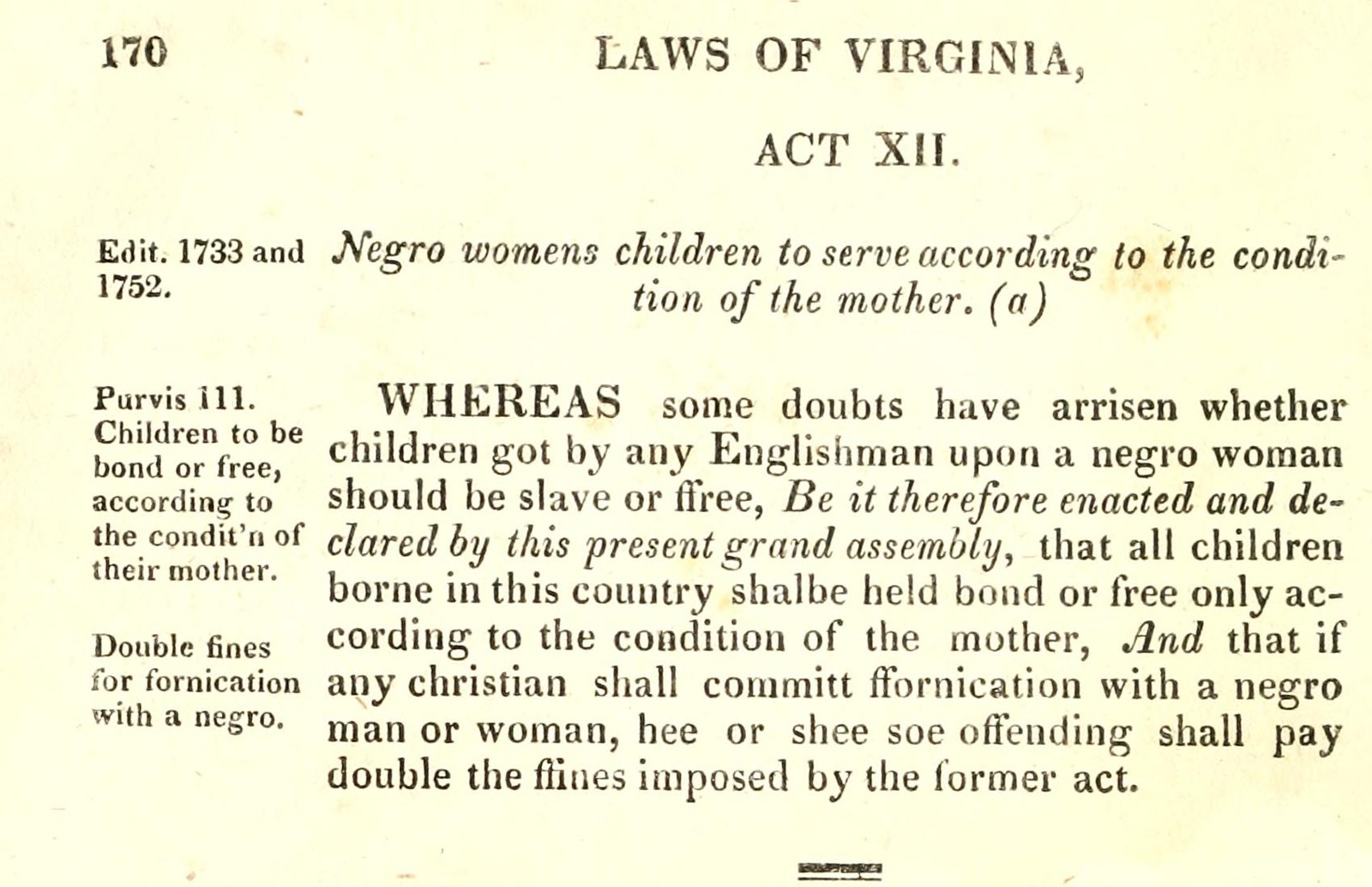
A Virginia statute · 1662
The law below appears here in Hening’s early nineteenth-century collection of Virginia statutes. This is a later printing of the colonial law, not its original manuscript. Detail shows Act XII.
WHEREAS some doubts have arrisen whether children got by any Englishman upon a negro woman should be slave or ffree, Be it therefore enacted and declared by this present grand assembly, that all children borne in this country shalbe held bond or free only according to the condition of the mother, And that if any christian shall committ ffornication with a negro man or woman, hee or shee soe offending shall pay double the ffines imposed by the former act.
Negro: a dated racial label for a Black person; retained only in the original historical text.
Partus sequitur ventrem: a Latin phrase used to describe the rule that a child’s legal status follows the mother’s.
Modern-English version · click to read
Editorial modern-English paraphrase, not a historical quotation. This reading aid follows the excerpt above; omissions remain marked. Dated or demeaning labels are replaced with respectful terms. Return to the original wording when interpreting the source.
Questions have arisen about whether children fathered by an Englishman and born to a Black woman should be enslaved or free. This assembly therefore declares that every child born in the colony will be held enslaved or free according only to the mother’s legal status. If a Christian has sexual relations outside marriage with a Black man or woman, that Christian must pay twice the fine required by the earlier law.
Virginia Assembly · 1667
Can baptism change bondage?
Baptism is admission into Christianity. Compare the doubt stated here with the committee’s discussion of Key’s faith. Legislatures could change the conditions under which people claimed freedom and enslavers expected to retain labor.
Reading focus: Compare the legislature’s stated concern with the grounds in Key’s claim.
WHEREAS some doubts have risen whether children that are slaves by birth, and by the charity and piety of their owners made pertakers of the blessed sacrament of baptisme, should be vertue of their baptisme be made ffree; It is enacted and declared by this grand assembly, and the authority thereof, that the conferring of baptisme doth not alter the condition of the person as to his bondage or ffreedome; that diverse masters, ffreed from this doubt, may more carefully endeavor the propagation of christianity by permitting children, though slaves, or those of greater growth if capable to be admitted to that sacrament.
Baptism: a Christian ceremony of admission to the faith.
Bondage: enslavement in this act.
Propagation: spreading or extending something; here, Christianity.
Modern-English version · click to read
Editorial modern-English paraphrase, not a historical quotation. This reading aid follows the excerpt above; omissions remain marked. Dated or demeaning labels are replaced with respectful terms. Return to the original wording when interpreting the source.
Questions have arisen about whether children enslaved from birth become free when their owners arrange Christian baptism for them, which the assembly describes as charitable and religiously devoted. This assembly declares that baptism does not change a person’s status as enslaved or free. The stated purpose is to remove masters’ uncertainty so that they may more readily spread Christianity by permitting enslaved children, and older enslaved people who can participate, to receive baptism.
Read forward to 1705. Notice which earlier rules continue and which distinctions become more explicit.
Virginia Assembly · 1705
Religion, racial categories, and permanent bondage
The 1705 Virginia act brings rules for servants and enslaved people into a wider statute. These selections address imported workers, treatment, punishment, baptism, and children’s status. Compare its categories and protections with the earlier documents.
Reading focus: Which earlier rules continue? Where does the act explicitly distinguish white servants?
IV. And also be in enacted, by the authority aforesaid, and it is hereby enacted, That all servants imported and brought into this country, by sea or land, who were not christians in their native country, (except Turks and Moors in amity with her majesty, and others that can make due proof of their being free in England, or any other christian country, before they were shipped, in order to transportation hither) shall be accounted and be slaves, and such be here bought and sold notwithstanding a conversion to christianity afterward.
VII. And also be in enacted, by the authority aforesaid, and it is hereby enacted, That all masters and owners of servants, shall find and provide for their servants, wholesome and competent diet, clothing, and lodging, by the discretion of the county court; and shall not, at any time, give immoderate correction; neither shall, at any time, whip a christian white servant naked, without an order from a justice of the peace: And if any, notwithstanding this act, shall presume to whip a christian white servant naked, without such order, the person so offending, shall forfeit and pay for the same, forty shillings sterling to the party injured […]
XXXIV. And if any slave resist his master, or owner, or other person, by his or her order, correcting such slave, and shall happen to be killed in such correction, it shall not be accounted felony; but the master, owner, and every such other person so giving correction, shall be free and acquit of all punishment and accusation for the same, as if such incident had never happened […]
XXXVI. And also it is hereby enacted and declared, That baptism of slaves doth not exempt them from bondage; and that all children shall be bond or free, according to the condition of their mothers, and the particular direction of this act.
Transportation hither: being taken to this colony.
Competent diet: sufficient food.
Immoderate correction: excessive punishment.
Justice of the peace: a local official with judicial powers.
Felony: a serious criminal offense.
Acquit: release from a criminal accusation or penalty.
Exempt: release from a requirement or status.
Modern-English version · click to read
Editorial modern-English paraphrase, not a historical quotation. This reading aid follows the excerpt above; omissions remain marked. Dated or demeaning labels are replaced with respectful terms. Return to the original wording when interpreting the source.
IV. All servants brought into the colony by sea or land who were not Christians in their home countries are to be considered enslaved and may be bought and sold even if they later convert to Christianity. Exceptions include people identified in the act as Turks and Moors whose communities are friendly with the queen, and people who can prove that they were free in England or another Christian country before being shipped to the colony.
VII. Masters must provide servants with healthy, sufficient food, clothing, and lodging, as determined by the county court, and must not punish them excessively. A Christian white servant may not be whipped while unclothed without an order from a justice of the peace. Anyone violating that requirement must pay the injured servant forty shillings. […]
XXXIV. If an enslaved person resists punishment by a master, owner, or someone acting under their orders, and is killed during that punishment, the killing is not to be treated as a felony. Those administering the punishment are released from accusation and punishment for it. […]
XXXVI. Baptism does not release enslaved people from bondage. Children are enslaved or free according to their mothers’ status and the specific provisions of this act.
1676–1677 · A crisis in the sequence
Bacon’s Rebellion: How much does one crisis explain?
Return to the crisis of 1676. The laws show how status was defined. Now step back from the 1705 act to ask whether political unrest helps explain why planters changed their labor choices.
In 1676, a dispute over Virginia’s frontier became a rebellion against Governor William Berkeley. Raids and retaliatory attacks had followed a 1675 conflict involving colonists, Doeg people, and Susquehannocks whom militia attacked despite their initial noninvolvement. Berkeley proposed forts and sought Indigenous allies. Colonists demanding broader attacks accused him of failing to protect settlements. Nathaniel Bacon, a wealthy planter and council member, led unauthorized attacks, including against Virginia’s Indigenous allies. Demands for land and violence against Indigenous peoples were central to the conflict.
The struggle also drew on resentment over taxes, favoritism, and unequal opportunities. Bacon’s followers turned against Berkeley’s government and burned Jamestown in September 1676. Their ranks included poorer colonists, servants, and enslaved people, alongside men with property and influence. Participation across statuses did not make their movement a campaign for racial equality. Bacon died in October; fighting continued until the rebellion collapsed in early 1677. The crisis exposed both conflict within colonial society and the violence of expansion onto Indigenous lands.
From the collections
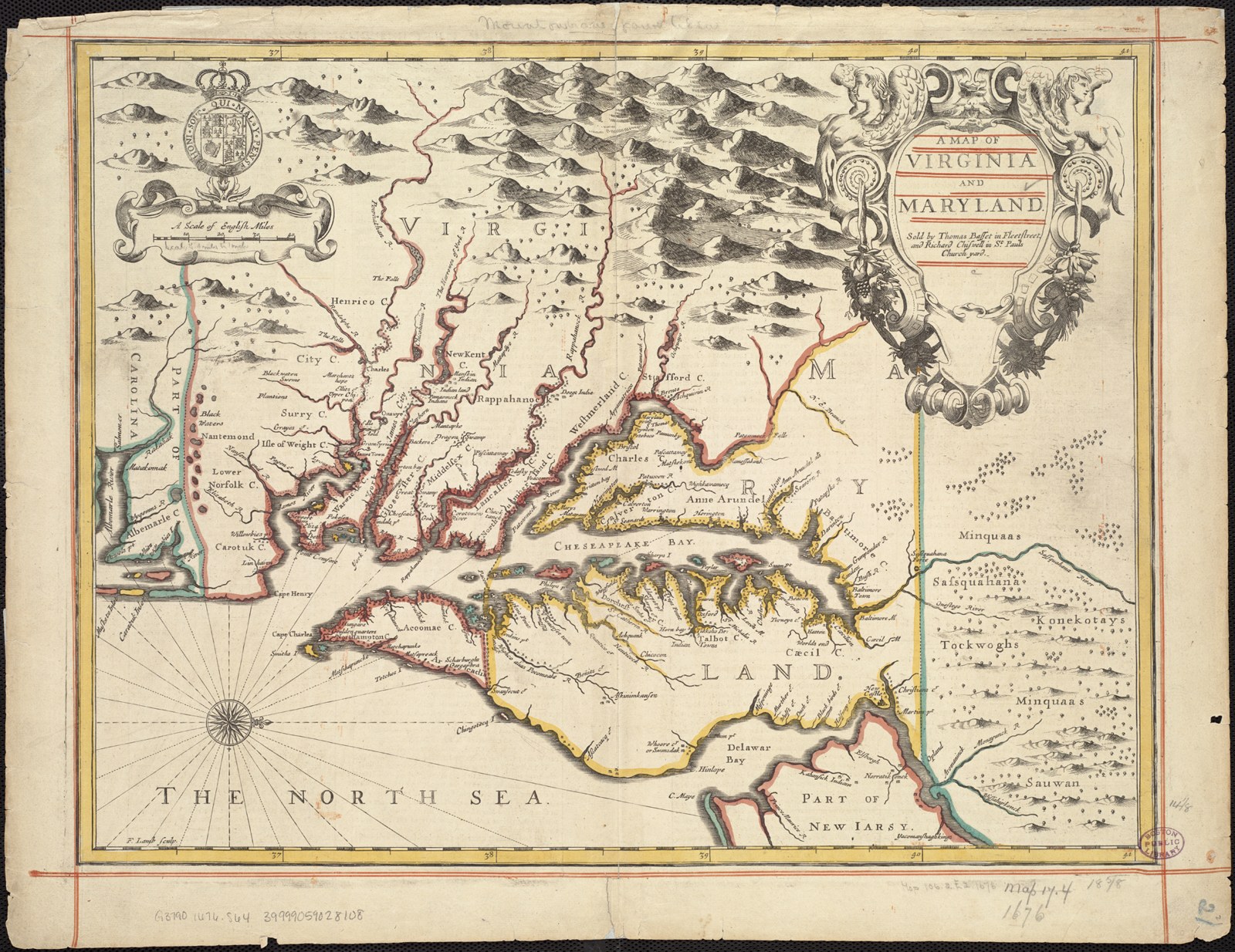
Virginia and Maryland · 1676
An English map from the year of Bacon’s Rebellion depicts Chesapeake waterways, settlements, and named Indigenous communities. It supplies geographical context, not a record of the rebellion’s events.
Bacon accuses Governor Berkeley of serving favorites instead of colonists. He was a wealthy council member, not simply a poor servant leader. His hostile descriptions of Indigenous peoples are partisan accusations. Notice how demands for political accountability connect to demands for colonial expansion and violence.
Reading focus: Track who is accused, what remedies are implied, and whose liberties the author defends.
For having upon specious Pretenses of public Works raised unjust Taxes, upon the Common [people], For advancing of Private Favorites. And other sinister Ends, but no visible Effect, in any Measure adequate.
For not having during the Long time of his Government, In any Measure advanced, this hopeful Colony, either by Fortifications, Towns, or Trade.
For having abused, and rendered Contemptable, his Maties [Majesty’s]: Justice, by advancing to Places of Judicature, scandalous and ignorant Favorites.
For having wronged his maties: Prerogative and Interest, by assuming the monopoly of the Beaver Trade.
For having in that unjust Gain, betrayed and sold, His Matie: Country, and the Liberties of his Loyal Subjects to the Barbarous Heathen.
For having, Protected, favored, and Emboldened the Indians against his Maties: most Loyal Subjects; never Contriving, requiring, or appointing any due or proper Means of Satisfaction; for their many Incursions, Murders, and Robberies, Committed upon Us.
For having when the Army of the English, was upon the Tract of the Indians, which now in all Places, burn, spoil, and Murder, And when We might with ease, have destroyed them, who were in open hostility.
For having expressly, countermanded, and sent back, our Army, by Passing his word, for the Peaceable demeanors of the said Indians, who Immediately prosecuted their Evil Intentions—Committing horrid Murders and Robberies, in all Places, being Protected by the said Engagement . . . having now drawn themselves into such obscure and remote places, and are by their success so Emboldened, and Confirmed, and by their Confederates strengthened.
[…]
Opening grievances selected through the allegation that Berkeley countermanded the army; remaining declaration omitted. The internal ellipsis is retained from the BRI transcription. Read the documentary transcription (opens in a new tab).
Terms in this passage
Specious pretenses: apparently reasonable excuses that the author calls misleading.
Judicature: the administration of justice or judicial offices.
Prerogative: an authority or privilege attached to an office.
Monopoly: exclusive control over a trade or market.
Heathen: a hostile historical label for people outside the author’s religion.
Incursions: raids or attacks into a territory.
Satisfaction: a remedy or compensation for an alleged wrong.
Countermanded: canceled or reversed an order.
Engagement: a promise or commitment.
Confederates: allies.
Modern-English version · click to read
Editorial modern-English paraphrase, not a historical quotation. This reading aid follows the excerpt above; omissions remain marked. Dated or demeaning labels are replaced with respectful terms. Return to the original wording when interpreting the source.
Bacon accuses Governor Berkeley of the following:
Using misleading claims about public works to impose unjust taxes on ordinary people, benefiting personal favorites and serving improper purposes without results matching the expense.
Failing during his long administration to improve this promising colony through forts, towns, or trade.
Undermining the king’s justice by appointing unqualified and disreputable favorites to judicial offices.
Violating the king’s authority and interests by taking exclusive control of the beaver trade.
Sacrificing the king’s country and loyal subjects’ liberties for that unfair profit in dealings with Indigenous peoples, whom Bacon describes with hostile religious language.
Protecting, favoring, and encouraging Indigenous peoples against the king’s loyal subjects, while failing to demand remedies for raids, killings, and robberies that Bacon attributes to them.
Bacon begins another accusation by describing English forces pursuing Indigenous enemies whom he accuses of burning, destroying property, and killing. He says the English could easily have destroyed them. He then accuses Berkeley of ordering the army to turn back after promising that those Indigenous people would remain peaceful. Bacon claims they continued attacks under the protection of that promise […] and then withdrew to remote places, encouraged by their success and strengthened by their allies.
[…]
Context: Bacon’s Rebellion, 1676–1677 (opens in a new tab). Earlier laws do not prove the rebellion had no later influence; the Declaration does not demonstrate a subsequent shift in labor purchases.
03 · Slavery differed by region
How did slavery differ outside the Chesapeake?
Hereditary enslavement did not produce one uniform society. Compare Carolina’s plantation calculations with Moraley’s Middle Colonies account: the scale, work, communities, and opportunities for independent activity differed.
Use the regional overview for context and the population table for scale. Norris and Moraley examine different subjects: compare what each reveals without assuming that what one author omits was absent from that region.
Chesapeake
Tobacco plantations and farms created sustained labor demand. Plantation size varied; enslaved people also performed domestic, skilled, and other work.
Lower South
Rice plantation expansion, Caribbean connections, and the enslavement and trade of Indigenous people shaped Carolina. Enslaved Africans brought agricultural knowledge; large enslaved populations could support communities different from those in smaller households.
Middle Colonies and New England
Slavery existed in farms, households, workshops, and ports alongside family, hired, and indentured labor. Regional population shares were generally smaller, but local concentrations varied. Northern commerce also connected these colonies to Atlantic slavery.
Different regional trajectories
Choose a colony or date to bring its estimates into focus. All values remain visible.
Estimated Black share of total colonial population (%)
Colony
1680
1700
1730
1750
Virginia
6.9
27.9
26.3
43.9
Maryland
9.0
10.9
19.0
30.8
South Carolina
15.7
42.9
66.7
60.9
New York
12.2
11.8
14.3
14.3
Pennsylvania
3.7
2.4
2.4
2.4
Historical estimates, not a primary-source workforce count. Source: Historical Statistics of the United States: Colonial Times to 1957 (1960), reproduced in the supplied Peter Kolchin excerpt, printed p. 57. Values checked against that reproduction, not underlying enumerations. Includes free and enslaved Black people; colony averages conceal local concentrations.
John Norris’s Profitable Advice for Rich and Poor uses fictional speakers to promote Carolina. The dialogue turns people into costs and expected returns. Its conditional claims reveal planter assumptions, not a reliable universal formula for profit or survival. Indigenous enslavement also appears in his account.
Reading focus: Read the question and answer together. Notice “with good Management and Success” and “if it proves well.”
From the collections
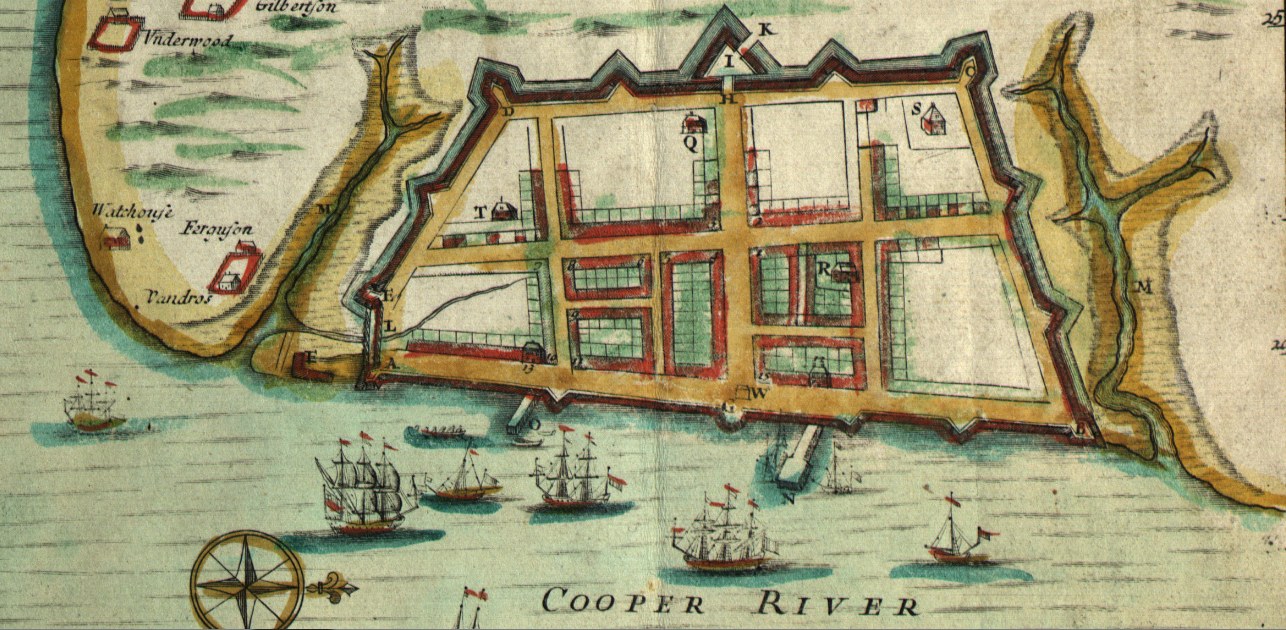
Charles Town · 1711
Ships and waterfront settlement place Carolina within its maritime setting. Detail from the Charles Town inset on Edward Crisp’s map, published one year before Norris’s promotional dialogue.
English Farmer. What Price may a Man purchase a Slave for at the best Hand? And what Sorts of Money is current for Payment, and what Value is it in Proportion to Money here in England?
Carolina Planter. An Indian Man or Woman may cost 18 or 20 Pound, but a good Negro is worth twice that Sum, we have passing as currant [currency] amongst us the Spanish Money, Pieces of differing Value according to its Weight, . . .
English Farmer. I see it hazardous for a Man to give so much Money for a Slave, and that Slave may soon die, then all his Money is lost.
Carolina Planter. Is it not so here, If a Man purchase Cattle or Horses, how can he be assur’d of their Lives? Yet we have a greater Encouragement to buy Slaves, for with good Management and Success, a Man’s Slave will, by his Labour, pay for his first Cost in about four Years at most, besides his Maintenance, so, the Remainder of his Life, you have his Labour as free Gain (we esteem their Eating and Wearing as little, for that rises on the Plantation and is little cost out of Pocket). When they are employ’d chiefly on planting Rice, and it proves well, a Slave’s Year’s Work may be worth the Master 25 or 30 Pounds a Year of the Crops of Rice that their Slaves doth plant, hoe, and manage for them as aforesaid.
At the best hand: on the most favorable purchasing terms.
Current: accepted for payment.
Maintenance: food, clothing, and other upkeep.
Free gain: additional return after costs, as the planter describes it; not freedom for the worker.
Negro: a dated racial label for a Black person; retained only in the original historical text.
Modern-English version · click to read
Editorial modern-English paraphrase, not a historical quotation. This reading aid follows the excerpt above; omissions remain marked. Dated or demeaning labels are replaced with respectful terms. Return to the original wording when interpreting the source.
English Farmer: What is the best price for purchasing an enslaved person? What money is accepted, and how does its value compare with money in England?
Carolina Planter: An enslaved Indigenous man or woman may cost eighteen or twenty pounds. An enslaved African whom a buyer considers valuable costs twice as much. Spanish coins circulate here, with values differing according to weight. […]
English Farmer: It seems risky to pay so much. The person might soon die, and the buyer would lose the entire investment.
Carolina Planter: Is there not a similar risk when someone buys cattle or horses? Their survival is not assured either. But I claim there is a greater incentive to purchase enslaved people: with successful management, their labor can repay their purchase price within about four years, as well as covering their upkeep. After that, the buyer receives the remaining years of labor as additional gain. We consider food and clothing a small expense because they are produced on the plantation and require little cash. If an enslaved person mainly plants rice and the crop does well, I claim that a year’s planting, hoeing, and tending can produce rice worth twenty-five or thirty pounds for the master.
William Moraley · 1743 · memoir of Middle Colony experience
Slavery beyond the plantation core
William Moraley, an English indentured servant, describes experience principally from the preceding decade. He is not an enslaved narrator. His legal claims require corroboration. Marriage did not create hereditary enslavement: law tied children’s status to their mother, whether or not parents married.
Reading focus: Look for both coercion and independent activity. Identify which legal assertions would require corroboration and what additional evidence would help test them.
The Condition of the Negroes is very bad, by reason of the Severity of the Laws, there being no Laws made in Favour of these unhappy Wretches: For the least Trespass, they undergo the severest Punishment; but their Masters make them some amends by suffering [allowing] them to marry, which makes them easier and often prevents their running away. The Consequence of their marrying is this, all their Posterity are Slaves without redemption; and it is in vain to attempt an Escape, tho’ they often endeavour it; for the Laws against them are so severe, that being caught after running away, they are unmercifully whipped; and if they die under the Discipline, their Masters suffer no Punishment, there being no Law against murdering them. So if one Man kills another’s Slave, he is only obliged to pay his Value to the Master, besides Damages that may accrue for the Loss of him in his Business.
The Masters generally allow them a Piece of Ground, with Materials for improving it. The Time of working for themselves is Sundays, when they raise on their own Account divers Sorts of Corn and Grain, and sell it in the Markets. They buy with the Money Clothes for themselves and Wives; as for the Children, they belong to the Wive’s Master, who bring them up […]
On their own account: for their own use or benefit.
Wretches: a demeaning historical word for people in a miserable condition.
Modern-English version · click to read
Editorial modern-English paraphrase, not a historical quotation. This reading aid follows the excerpt above; omissions remain marked. Dated or demeaning labels are replaced with respectful terms. Return to the original wording when interpreting the source.
Moraley describes enslaved Black people’s condition as very harsh because of severe laws. He claims that no laws protect them and that even small offenses receive severe punishment. He says masters allow marriage partly because it makes people less unhappy and may discourage escape. He then claims that marriage makes all descendants enslaved with no release. He describes escape attempts as frequent but difficult, and says people caught after fleeing are severely whipped. He claims that masters are not punished if someone dies during punishment, and that killing enslaved people is not prohibited. He says someone killing another person’s enslaved worker must pay the owner the worker’s assessed value and compensate for lost business.
Moraley says masters generally allow enslaved people a plot and materials to cultivate it. On Sundays, people grow different kinds of grain for themselves and sell the produce in markets. They use the money to buy clothing for themselves and their wives. He says children belong to the wife’s enslaver, who raises them. […]
Interpretive close · Causation
Explain the labor transition.
Write your final explanation in the companion assignment, connecting a change in conditions, a planter incentive or ability, and a legal rule. Your regional comparison belongs in Checkpoint 4; no additional regional response is required here. Discussion, paper notes, and the thinking desk below are optional preparation.
Distinguish a continuing condition, a pressure that intensified, a decision that changed the rules, and a consequence. A development can do more than one kind of causal work. A persuasive explanation supplies a mechanism and dated evidence, not just an event’s name.
Before you submit · check your reasoning
Have I connected at least two causes by explaining how they interacted, rather than simply listing them?
Have I used at least three specific pieces of evidence, including two primary sources and a legal provision?
Have I explained what changed in enslaved status, using dated evidence?
Have I distinguished evidence of a labor shift from evidence of the motives behind it?
Have I addressed a relevant continuity or limitation?
A term of service increasingly gave way to lifelong, hereditary control in the Chesapeake. Laws helped entrench racial hierarchy; slavery took different forms elsewhere.
Optional review—not an additional assignment. Revisit any developments that help you think through the exhibit. If useful, connect two developments in your own words before opening “How it connects.” Theme buttons emphasize related cards and provide jump links. Spacing is not proportional to elapsed time, and overlapping dates do not imply inevitable steps.
All developments are shown. Open any card to revisit its connections.
1610s–1630s
Recruiting a workforce
English migration and terms of service helped meet Chesapeake tobacco labor demand.
How it connects
For people facing poverty or limited opportunities, passage could be difficult to afford. Service offered a route across the Atlantic, but masters controlled the work and prospects of independence were uncertain. Not all recruitment was voluntary.
A structural condition: demand for work connected with unequal access to migration and resources.
Frethorne describes hardship and asks his family to redeem him.
How it connects
His plea reveals the risks of service and his effort to change his circumstances. It cannot establish how every servant lived. A term with an endpoint could still be coercive and dangerous.
Experience and agency: a source about the system’s consequences, not proof of a later shift by itself.
Servant supply, survival, planter resources, and Atlantic trade altered the attraction of long-term labor control.
How it connects
These conditions overlapped the legal and political developments below. Expanding access to captive Africans and expectations of longer survival could make lifetime labor more attractive to planters with capital. Costs and choices varied; no change guaranteed the outcome.
Why the labor balance shifted: explain how overlapping changes affected planter choices, then distinguish those incentives from laws defining status.
Hammond presents service as a route toward livestock, tobacco, and independence.
How it connects
The pamphlet links years of service to hopes of acquiring an estate, while warning that land must be secured in the agreement. Its promises help explain the attraction of migration; they do not prove typical outcomes or describe what Frethorne read decades earlier.
A recruitment incentive: compare the promised future with the risks of lived service.
Officials consider service obligations, a free English father, and Christian baptism in Key’s claim.
How it connects
The report shows overlapping grounds for freedom and Key’s pursuit of it through colonial institutions. It is not a final judgment. Early status was not defined by religion alone; ancestry, origin, and unequal treatment also mattered.
A contested legal position: compare these possible grounds with the rules that followed.
Virginia makes a child bond or free according to the mother’s condition.
How it connects
For children of enslaved women, maternal inheritance secured hereditary bondage even when a father was free. The rule connected control over labor with control over descendants. It did not mean every Black person was enslaved.
A legal choice with consequences: it reinforced hereditary status, not simply the length of one person’s service.
Virginia declares that baptism does not change enslavement or freedom.
How it connects
Lawmakers removed uncertainty about whether Christian conversion could end bondage. Read this alongside Key’s faith and the 1662 rule: religion remained important, but conversion could no longer undo inherited enslavement.
An enabling rule: it narrowed a possible freedom claim and secured enslavers’ expectations.
Elite fears of unrest may have mattered alongside economic and demographic changes already underway.
How it connects
One interpretation connects servant discontent and elite fears to stronger racial divisions. A wider explanation emphasizes servant supply, labor demand, planter resources, survival, and Atlantic access to captive Africans. The later demographic shift does not prove one motive. Laws passed in 1662 and 1667 show that legal entrenchment had begun before the rebellion.
A contributing crisis to investigate: the Declaration alone cannot demonstrate later labor purchases.
Virginia combines religious-origin rules, explicit white-servant protections, and hereditary bondage in a wider act.
How it connects
Religious language persists; later conversion cannot end enslavement. The act distinguishes white servants and reinforces unequal protections. Racial hierarchy acquired changing, enforceable meanings through law and practice. Servitude still existed alongside slavery.
Codification and reinforcement: continued religious wording complicates a clean religion-to-race switch.
Norris promotes rice-plantation labor through conditional claims about costs and returns.
How it connects
His dialogue reveals commodification and planter assumptions in the Lower South, including Indigenous enslavement. It is promotional writing, not a recorded interview or a universal profit formula. Carolina’s economic and Atlantic connections differed from the Chesapeake’s.
Regional comparison: rice plantation work, population scale, and Caribbean connections differed from Chesapeake tobacco settings.
Moraley describes coercion, inherited status, family relationships, and market activity outside the Chesapeake.
How it connects
His memoir principally describes experience from the preceding decade; publication is not the date slavery began there. Enslaved people could undertake activity for themselves while remaining subject to coercion. Moraley’s legal claims need corroboration; marriage did not create hereditary status.
Regional comparison: smaller population shares coexisted with slavery in farms, households, workshops, and ports; coercion persisted.
Revisit your explanation: Do your two selected developments change the weight you give any cause? Revise your interpretation if the evidence warrants it.
The evidence is embedded above. Supplementary repository links are not needed to complete the investigation. Excerpts follow documentary transcriptions, not quotations taken from secondary narrative. Paragraph breaks are added for reading; omissions and existing glosses are visible.
John Hammond, Leah and Rachel (1656) (opens in a new tab): two noncontiguous complete paragraphs on provisions at expiration and prospects for an estate. EEBO-TCP A87050, British Library reproduction; long s standardized and line-break hyphenation joined.
A servant asks to be redeemed (opens in a new tab) · 1623 · Virginia. Two separated passages; omissions and the transcription’s bracketed glosses retained. [Goodman Jackson] is an added editorial identification of the man named earlier in the letter.
Bacon’s Declaration of the People (opens in a new tab) · 1676 · Nathaniel Bacon. Opening grievances selected through the allegation that Berkeley countermanded the army; remaining declaration omitted. The internal ellipsis is retained from the BRI transcription.
Hammond: London, printed by T. Mabb, sold by Nich. Bourn near the Royal Exchange, 1656; EEBO-TCP A87050. Frethorne: Susan Kingsbury, Records of the Virginia Company, vol. 4 (1935), pp. 58–62. Key: Billings (1975), pp. 197–198. Virginia acts: William Waller Hening, Statutes at Large, vol. 2 pp. 170, 260; vol. 3 pp. 447–463.
Norris and Moraley: National Humanities Center selections credit Jack Greene, Selling a New World (1989), and Susan Klepp / Billy Smith, The Infortunate (1992; 2005). Modern editorial introductions are excluded from quotations.
Bacon: opening grievances compared with the BRI transcription. Its linked Virtual Jamestown document was inaccessible during this audit; manuscript metadata at Encyclopedia Virginia / Colonial Williamsburg (opens in a new tab) corroborates document identity, not every transcription character. No independent archival collation is claimed.
Each source includes a closed vocabulary guide and modern-English reading aid. Reading aids are editorial paraphrases, not quotations or new evidence. They replace dated labels with respectful language, preserve omissions, and identify uncertainty or unsupported legal claims.
Modern-English aids keep editorial corrections in separately labeled notes where needed. They are reading supports, not replacement primary sources.
Historical scholarship and APUSH alignment
Interpretive references supplied for planning: Ira Berlin, “Time, Space, and the Evolution of Afro-American Society on British Mainland North America,” American Historical Review 85, no. 1 (1980), pp. 44–78; Peter Kolchin, supplied “Economic Origins” excerpt from Unfree Labor (1987), printed pp. 55–63. These support attention to time, place, labor scarcity, planter calculations, community, and agency; students are not required to read them.
AP U.S. History Course and Exam Description (opens in a new tab), Fall 2026: Topic 2.3 (British colonial regions), 2.4 (transatlantic trade), and 2.6 (slavery in the British colonies). Causation is the central skill; continuity and change, comparison, and sourcing support the investigation. The Chesapeake case does not stand for all British North America.