1776
Declaration of Independence
It announces independence, but it also explains why governments exist, where legitimate power comes from, and when political authority may be resisted.
Flagship Exhibit · Period 3 · 1776 → 1861
The Declaration, the Constitution, and the American Experiment
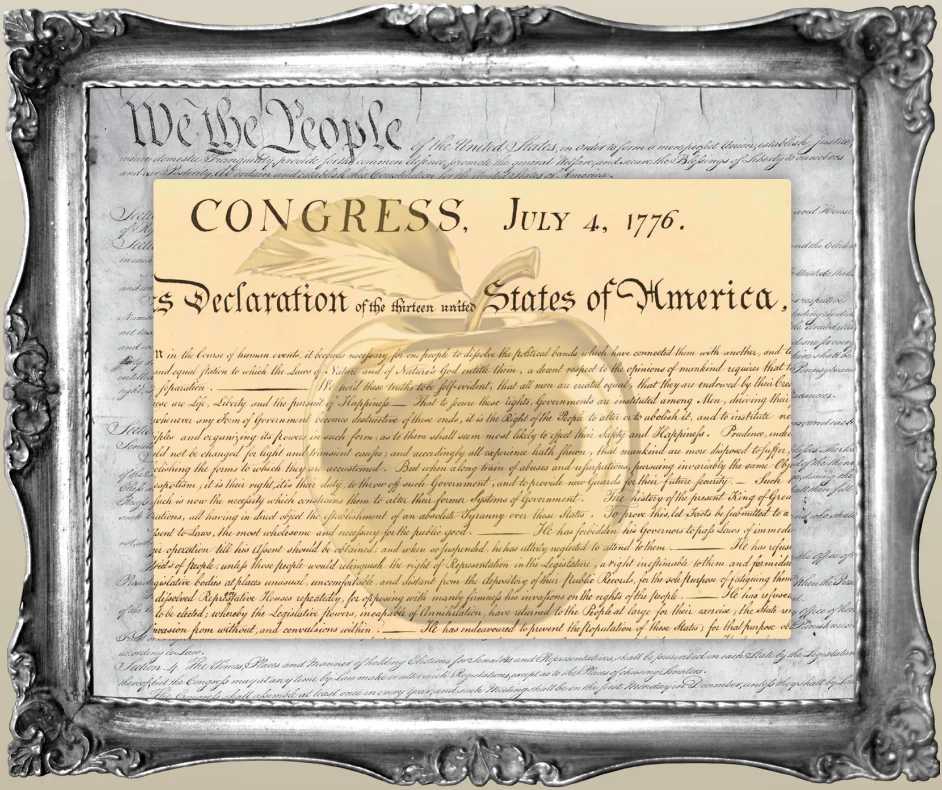
A visual interpretation of the metaphor Lincoln would use in 1861. Its meaning is the destination of this exhibit.
Companion Assignment · 20 points
This exhibit and your Google Assignment are designed to work together. Open the assignment through Canvas in a second tab, then return here. As you move through the exhibit, checkpoints will tell you when you have enough evidence to complete each response.
Prologue · Two Documents, One Experiment
Keep that puzzle in view. The exhibit will ask whether ideals and institutions do different jobs—and what happens when the two collide.
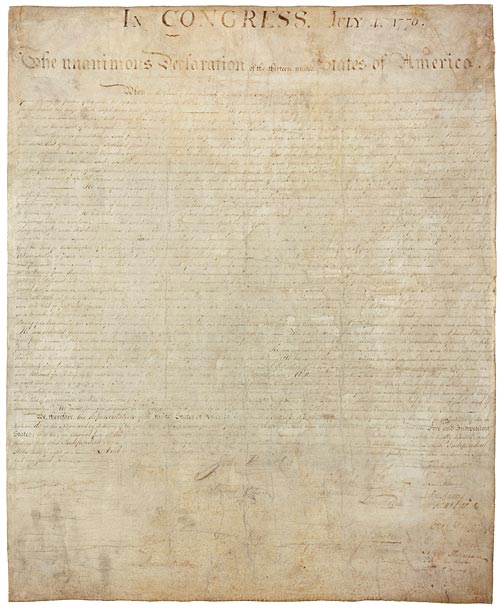
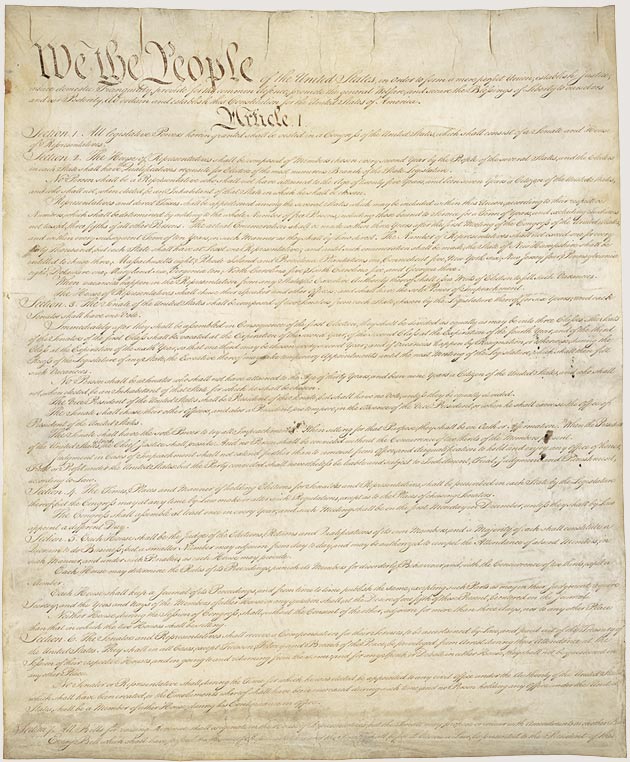
Before reading any interpretation, inspect the documents as artifacts. What does each document appear to be trying to do?
1776
It announces independence, but it also explains why governments exist, where legitimate power comes from, and when political authority may be resisted.
1787
After a brief statement of purposes, it spends most of its text creating institutions, powers, procedures, relationships, and limits for governing.
Quick prediction
Make a prediction. You will test it throughout the exhibit.
1776 · The Promise
Declaration of Independence · Select a highlighted idea
We hold these truths to be self-evident, that , that they are endowed by their Creator with certain , that among these are Life, Liberty and the pursuit of Happiness.—That , deriving their just powers from the , —That whenever any Form of Government becomes destructive of these ends, it is the …
Declaration of Independence, July 4, 1776 · transcript verified against the National Archives
Select each step to unpack the Declaration's logic.
1781–1787 · The Problem
Under the Articles of Confederation, Americans deliberately created a weak central government after rebelling against concentrated imperial authority. The system achieved important things—including directing the war effort, securing the Treaty of Paris, and organizing western lands—but serious structural weaknesses became harder to ignore.
Choose the two weaknesses you think would most threaten the survival of the union.
A confederation built around state sovereignty becomes the first national constitutional system.
The Treaty of Paris recognizes U.S. independence—but peace exposes financial and diplomatic weaknesses.
An armed uprising in Massachusetts intensifies elite fears about disorder and governmental capacity. It is one factor among several pushing reform.
Delegates authorized to revise the Articles instead design an entirely new constitutional framework.
The next section asks how the Constitution tried to create that capacity without simply recreating the concentrated power Americans had just rejected.
1787 · The Framework
Constitution · Preamble
“We the People of the United States, in Order to form a more perfect Union, establish Justice, insure domestic Tranquility, provide for the common defence, promote the general Welfare, and secure the Blessings of Liberty…”
The Preamble states purposes. The seven numbered sections of the Constitution—Articles I through VII—then build the machinery of government. Throughout this section, “Article I,” “Article II,” and so on refer to the Constitution, not the Articles of Confederation.
Interactive · Select a governing problem
The Constitution vests federal legislative powers in a bicameral Congress. Compared with the Articles of Confederation, the new national government receives enumerated powers including taxation and regulation of interstate and foreign commerce.
“The means ought to be proportioned to the end.”
Hamilton argues that assigning a national responsibility without supplying adequate power makes effective government impossible.
Interpretation Challenge
Select an ideal. The exhibit will surface constitutional mechanisms that can be interpreted as supporting it—and tensions that complicate the connection.
Separated institutions, checks and balances, regular elections, enumerated federal powers, and—after ratification—the Bill of Rights.
Every grant of governmental power that can protect liberty can also be abused. The Constitution therefore makes arguments about both capacity and restraint.
1787–1791 · The Debate
One shared goal · Two competing diagnoses
Madison begins with a problem inside popular government itself: citizens form factions, and a majority faction can use political power against the rights of others. His solution is not less liberty, but a larger representative republic.
“By a faction, I understand a number of citizens, whether amounting to a majority or minority of the whole, who are united and actuated by some common impulse of passion, or of interest, adverse to the rights of other citizens, or to the permanent and aggregate interests of the community.”
“There are two methods of curing the mischiefs of faction: The one, by removing its causes; the other, by controlling its effects.” Yet destroying liberty would be “worse than the disease”: “Liberty is to faction, what air is to fire, an aliment without which it instantly expires.”
“Extend the sphere, and you take in a greater variety of parties and interests; you make it less probable that a majority of the whole will have a common motive to invade the rights of other citizens; or if such a common motive exists, it will be more difficult for all who feel it to discover their own strength, and to act in unison with each other.”
Brutus accepts that the Confederation needs more energy. His objection is that the proposed Constitution may go much further—toward consolidation, broad national power, and a government too distant from the people.
“We have felt the feebleness of the ties by which these United States are held together, and the want of sufficient energy in our present confederation, to manage, in some instances, our general concerns.”
“The first question that presents itself on the subject is, whether a confederated government be the best for the United States or not? Or in other words, whether the thirteen United States should be reduced to one great republic, governed by one legislature, and under the direction of one executive and judicial…” Brutus warns that the proposed government “approaches so near” to consolidation that it may ultimately terminate in it.
“A free republic cannot succeed over a country of such immense extent…” And because the people govern through representatives, Brutus argues that in a large country it is impossible to create a representation that knows and faithfully declares the people's sentiments without becoming too numerous and unwieldy to govern effectively.
The debate changes the frame
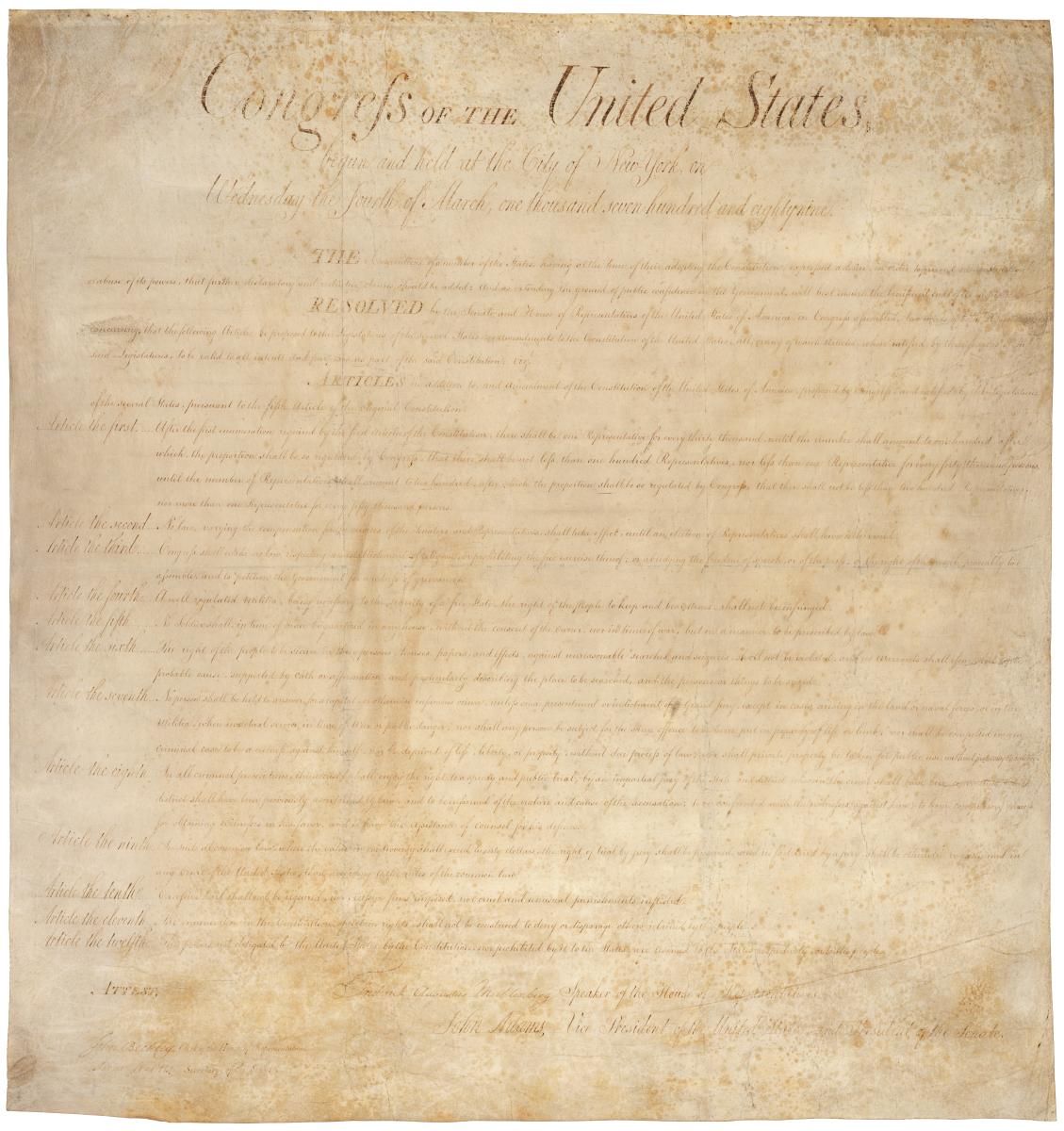
Ratification pressure helped produce a political commitment to add protections. Congress proposed twelve amendments in 1789; ten were ratified in 1791.
Restricts Congress from abridging core expressive and religious freedoms. The amendment illustrates a crucial constitutional move: liberty can be protected not only by structuring power, but by explicitly prohibiting certain uses of it.
The Contradiction
“All men are created equal.” A Constitution that accommodated and protected slavery.
The Constitution did not use the words slave or slavery, but it contained provisions that protected the interests of slaveholding states and increased their political power. The contradiction was not incidental to the founding settlement; it was embedded in compromises necessary to secure agreement among the states represented at Philadelphia.
Representatives and direct Taxes… [were apportioned by counting] the whole Number of free Persons… and three fifths of all other Persons.
Enslaved people could not vote, but counting three-fifths of the enslaved population for apportionment increased the representation of slaveholding states in the House and, through the Electoral College, their influence over presidential elections.
See the mechanism
This simplified illustration does not reproduce an actual 1787 state. It isolates the constitutional arithmetic so you can see the political effect.
Not the enslaved people being counted. The additional representation strengthened the political influence of the state’s electorate and officeholders—who excluded enslaved people from political participation.
Interpretive pause
Choose an interpretation. The exhibit will not tell you that the historical question has only one defensible answer.
January 1861 · The Apple and the Frame
After Lincoln’s election and amid the secession crisis, he wrote a private fragment reflecting on the Constitution, Union, and the Declaration. Drawing on the biblical image of “apples of gold in pictures of silver,” he treated the documents as related—but not equal in purpose.
Select the metaphor
“That something, is the principle of ‘Liberty to all’…”Abraham Lincoln, Fragment on the Constitution and Union, c. January 1861
His metaphor is evidence about how Lincoln understood the Founding during the secession crisis. It is also an interpretation that must be tested against the founding-era record.
Lincoln's argument
Lincoln interpreted the Declaration’s principle of liberty as the deeper purpose, and the Constitution and Union as structures created to preserve it. In his metaphor, constitutional government is indispensable—but it is a means serving an end.
“The picture was made for the apple—not the apple for the picture.”
A strong answer may conclude that he is doing some of both. Use evidence rather than assuming his metaphor is self-proving.
The Unfinished Experiment
“We hold these truths to be self-evident: that all men and women are created equal…”
The organizers at Seneca Falls deliberately rewrote the Declaration’s language. Their argument depended on the founding principle having authority beyond the political arrangements of 1776.
Conclusion · Return to the Essential Question
You began with a question about the relationship between ideals and institutions. You have now seen that the answer is historically powerful precisely because it is not simple: the founding created principles, governing structures, conflicts, compromises, and arguments that later generations inherited.
What is the relationship between the ideals expressed in the Declaration of Independence and the system of government created by the Constitution?
Your companion assignment is where you make your own historical judgments about that question.
Finished?
Before submitting, make sure you addressed every part of Questions 1–6 and completed the final reflection. Your assignment is worth 20 points.
Return to Canvas & SubmitAPUSH Connection
The founding documents recur across AP U.S. History because later political movements repeatedly interpret, invoke, revise, and contest them. A strong historical argument distinguishes between principles, institutions, and historical practice rather than treating “the founding” as a single undifferentiated idea.
Sources & Historical Notes
Primary-source excerpts and core factual claims in this exhibit were checked against authoritative collections. Document scans shown here are hosted by the U.S. National Archives; its high-resolution founding-document images are identified by the Archives as public domain.
Interpretive note: Lincoln’s “apple/frame” relationship is Lincoln’s 1861 interpretation of the founding—not a claim that all framers in 1787 understood the Declaration and Constitution in precisely the same way. The exhibit uses his metaphor as an interpretive lens and makes that distinction explicit.
Return to The American Experiment